Get Full Government Meeting Transcripts, Videos, & Alerts Forever!
Get email alerts on the State Legislation topic
No spam. Unsubscribe anytime.
County IGR updates committee on sponsored bills, guardianship and higher‑education proposals
Summary
The county’s intergovernmental relations office briefed FGOC on March 18 about a slate of sponsored and cosponsored bills in Sacramento, including measures on judgment enforcement, higher‑education access for systems‑involved youth and standby guardianship for immigrant caregivers.
The Office of Intergovernmental Relations provided a monthly state legislative update to the Finance and Government Operations Committee on March 18, highlighting the county’s sponsored and cosponsored bills and current committee schedules in Sacramento.
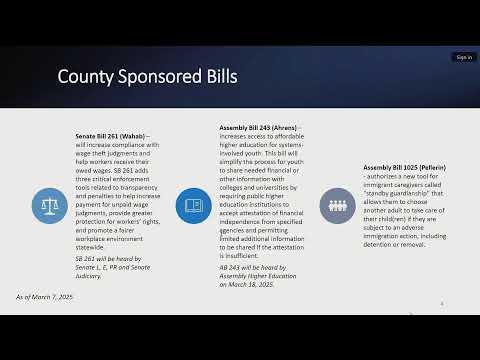
Program Manager Monica Tong said the county secured authors and filed three sponsored bills early in the session. She described SB 261 (authored by Senator Wahab) as a measure to increase transparency and triple penalties for chronic nonpayment to encourage businesses to satisfy outstanding judgments; the bill was scheduled for a Senate policy committee hearing. AB 243 (authored by Assemblymember Patrick Ahern) seeks to expand access to higher education for systems‑involved youth and was being heard by the Assembly Committee on Higher Education while the meeting was in session; IGR said a secure‑track youth from probation was testifying in support. AB 1025 (authored by Assemblymember Gail Pellerin) authorizes a standby guardianship tool for immigrant caregivers to name an adult to care for a child if the caregiver faces immigration detention or removal.
Tong also described two cosponsored bills: SB 33 (authored by Senator Cortese), which would establish a California guaranteed‑income program for students (California Success, Opportunity, and Academic Resilience program) and was set for a Senate education committee hearing; and AB 632 (authored by Assemblymember Greg Hart), intended to streamline code‑enforcement procedures in partnership with RCRC.
Tong gave an update on the newly formed Office of Health Care Affordability (OCHA), noting prior methodology proposals and county engagement to ensure public hospitals were not grouped as ‘high‑cost’ inappropriately. She said county staff would continue to monitor OCHA methodology and lower spending targets as they are finalized.
The committee voted to receive the legislative report.