Get Full Government Meeting Transcripts, Videos, & Alerts Forever!
Get email alerts on the Service Animals topic
No spam. Unsubscribe anytime.
Oklahoma House passes bill banning misrepresentation of service animals, 52-28
Summary
The Oklahoma House approved House Bill 1178, which makes it a misdemeanor to misrepresent a pet as a service animal, after extended floor debate over enforcement, privacy and education. The measure passed final passage by a 52-28 vote.
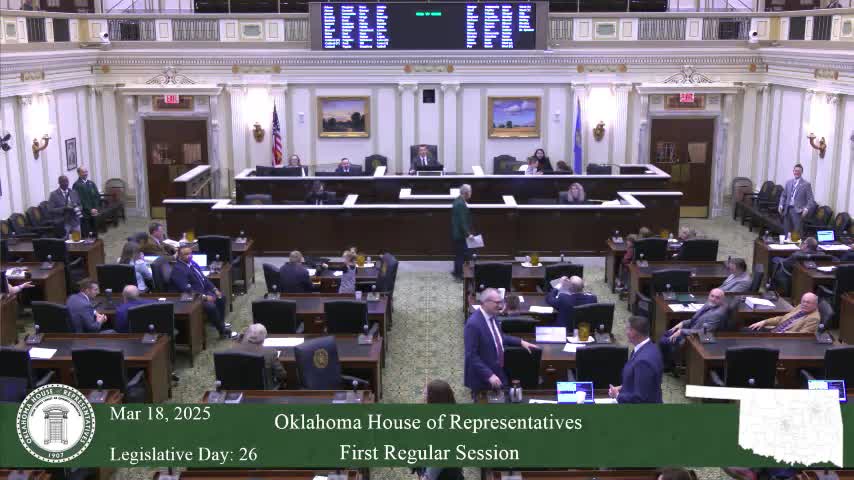
House Bill 1178, a measure making it illegal to misrepresent an animal as a service animal, passed final passage on the Oklahoma House floor by a 52-28 vote.
The bill’s sponsor, Representative Stark, said the measure is intended to protect people who rely on trained service animals by holding accountable those who falsely claim an animal is a service animal. Stark said, "Don't lie about what your animal is." The bill creates a misdemeanor penalty for misrepresenting a service animal.
Supporters and opponents debated enforcement and civil-rights implications. Representative Hefner, speaking at length against the bill, said the Americans with Disabilities Act provides the standard for determining service animals and warned the misdemeanor penalty could harm people with invisible disabilities. "Education, we should always start with education," Hefner said, arguing the bill could pressure people with disabilities to disclose private medical information. He and others noted the ADA includes no paperwork or uniform identification for service-animal users, which complicates on-the-spot enforcement by businesses and law enforcement.
Members asked how the bill would interact with the ADA and how businesses or police would determine whether an animal qualifies. Representative Fugate pressed the sponsor on proof standards and whether the bill would leave determinations to courts; Stark replied that the ADA standard — being able to explain what the animal is trained to do — would apply and that proof has long been handled by courts. The sponsor said education is important but declined to put training requirements in the bill, saying education efforts can change and the misdemeanor is intended to create accountability for people who misrepresent animals.
Several members sought safeguards for privacy and to avoid unintended consequences, including potential discrimination against people with invisible disabilities. Other supporters described constituents who said they avoid public life because of untrained animals being presented as service animals.
Representative Stark moved final passage; the clerk opened debate and then the House voted. The roll call produced 52 yes and 28 no, and the presiding officer declared the bill passed.
The record on the House floor shows repeated questions about enforcement, training and whether the bill would deter legitimate service-animal users from public life. The bill’s sponsor indicated willingness to discuss education with the Senate but stood by the misdemeanor as a tool to discourage false claims.