Get Full Government Meeting Transcripts, Videos, & Alerts Forever!
Get email alerts on the Veterans Benefits topic
No spam. Unsubscribe anytime.
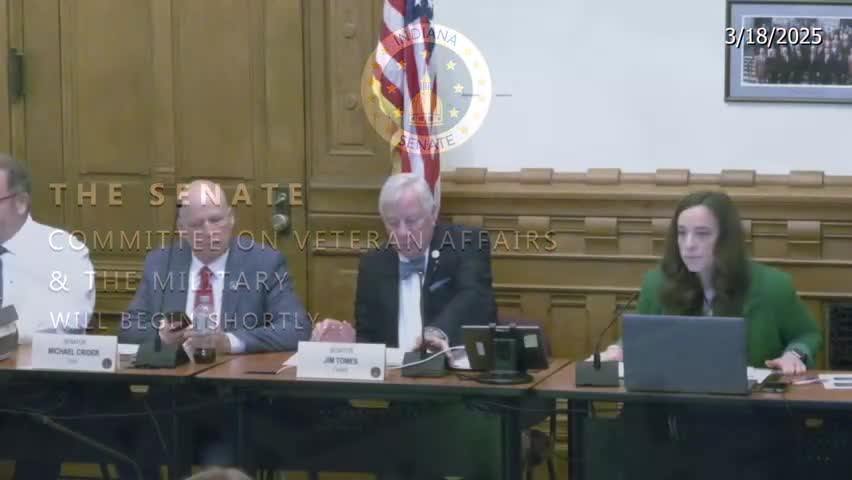
Senate Committee Hears Bill to Regulate Paid Veteran‑claim Assistants; Attorney General Warns of Federal Conflict
Summary
The Indiana Senate Veterans Affairs Committee on House Bill 1670 heard testimony on a proposal to regulate paid companies that assist veterans with VA claims, a measure supporters said would protect veterans from predatory "claim sharks" while the state attorney general's office warned the bill conflicts with federal accreditation and fee rules.
The Indiana Senate Veterans Affairs Committee on House Bill 1670 heard testimony on a proposal to regulate paid companies that assist veterans with Department of Veterans Affairs claims, a measure supporters called the "Veteran Empowerment Act" and critics said may conflict with federal law.
Senator Baldwin, who presented the bill, told the committee that "House Bill 16 70 in its current form would empower veterans to seek local assistance with applying for veteran benefits through creating a Veteran Empowerment Act." He said the bill seeks to set "strict rules and regulations for people and organizations working to assist our veterans" and to address "bad actors" sometimes described in testimony as "claim sharks." Baldwin described the problem as in part one of access and paperwork, saying in his own experience it took several attempts to obtain a disability rating because of administrative errors.
The bill would require paid preparers to disclose that free options exist and would cap compensation for paid assistance at "five times the amount of the increase or a maximum of $12,000," language supporters described to the committee. Proponents said the bill aims to allow veterans a paid option while protecting them from deceptive or predatory practices.
Proponents' testimony
William Taylor, cofounder and CEO of Veterans Guardian VA Claims Consulting, described his firm as a veteran‑staffed business that helps veterans navigate the VA disability process. Taylor said his company is "averaging a 90% success rate," that veterans receive decisions "in about 85 days," and that "our average veteran's getting $900 to $1,000 more a month in benefits." He said his company operates as an unaccredited entity under current federal accreditation constraints and urged the committee to "put guardrails and protections in place for what is currently an unregulated space," adding, "I'm coming to you as an industry representative saying please regulate me."
Peter O'Rourke, president of the National Association for Veteran Rights and a former acting U.S. secretary of Veterans Affairs, described the evolution of VA claims processes and the growth of non‑accredited paid services after creation of the fully developed claim process. He urged the committee to view the bill as a step toward modernizing access and said paid alternatives grew to fill a gap in services.
Other veteran advocates, including Lisa Wilkin (a U.S. Air Force veteran and Indiana Military Veterans Hall of Fame inductee) and representatives of veterans organizations, backed the bill's intent to stop predatory actors. Wilkin recounted a case she brought to a congressional office: a World War II veteran who paid $1,400 to a private firm, then waited 13 months for action; she said she secured a refund and the claim was completed by a county veteran service officer. Wilkin recommended requiring a signed form showing veterans have been informed that free VA assistance is available.
Concerns from the Attorney General and legal counsel
Michelle Aylia, deputy attorney general in the Consumer Protection Division speaking on behalf of Attorney General Todd Rokita, told the committee the Office of the Attorney General opposes HB 1670 as drafted. "HB 16 70 as it is currently written conflicts with federal law and would have the unintended consequence of giving cover to many whose conduct may be less bad but who are nevertheless still violating federal laws related to VA benefits," she said.
Aylia told the committee that under federal law, "any person who assists a veteran with preparing a claim for VA benefits must be accredited by the VA to do so" and that federal law "prohibits the charging of any fees for assisting a veteran for the initial preparation of a claim." She warned that the state bill could undercut the Office of the Attorney General's ability to enforce Indiana's Deceptive Consumer Sales Act against companies who charge veterans for prohibited services, and she cited 38 U.S.C. § 5901 and § 5904 as the federal provisions governing accreditation and fee rules.
Other witnesses and suggested amendments
Representatives of veterans organizations including the Veterans of Foreign Wars expressed conditional support but asked that any final language align with federal statutes and leave no doubt about prohibited conduct. Several witnesses asked that the bill require a standard state form be provided to veterans that identifies free accredited resources and spells out how fees will be calculated and collected.
Committee process and next steps
Committee members did not vote on HB 1670 during the hearing. Multiple witnesses and the presenting senator said an amendment was expected and that the committee would take further action next week; as the hearing opened, the chair stated that the committee would "only take testimony on this bill" and that "next week we'll amend and vote on it." The record shows the committee left the measure open for amendment to address federal preemption concerns and to refine fee and disclosure rules.
Why this matters
Witnesses described a mix of legitimate paid services and predatory actors operating in an area constrained by federal accreditation rules. Supporters said the bill would give veterans clearer consumer protections and permitted paid alternatives; the state attorney general's office warned that any statute which permits what federal law forbids could complicate existing consumer‑protection enforcement and conflict with federal law. The committee signaled it will seek language intended to bridge those concerns before a scheduled vote.
The committee will reconvene on the bill for amendment and possible vote at a subsequent session.