Get Full Government Meeting Transcripts, Videos, & Alerts Forever!
Get email alerts on the Caregiver Support topic
No spam. Unsubscribe anytime.
Senior Source describes caregiver supports, warns of gaps in South Dallas
Summary
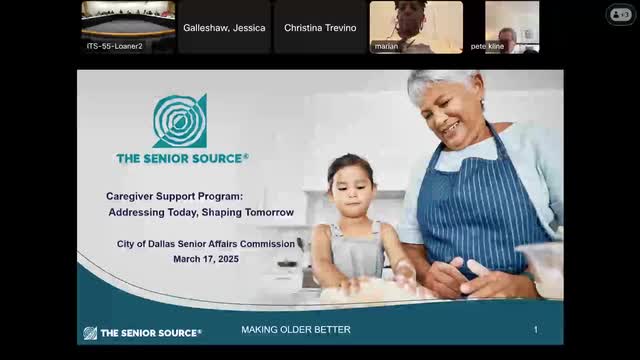
At a March 17 meeting of the Dallas Senior Affairs Commission, Kimberly Knight of the Senior Source outlined programs for family caregivers, reported that the agency served about 2,250 caregivers last year and said respite and financial help remain the biggest unmet needs—particularly in South Dallas and among men and Black LGBT seniors.
Kimberly Knight, director of caregiver support at the nonprofit Senior Source, told the Dallas Senior Affairs Commission on March 17 that the organization offers case management, education, support groups and a volunteer telephone check-in program aimed at reducing caregiver stress.
Knight said the Senior Source’s caregiver support program served about 2,250 caregivers last year and that 82 percent of those who used services reported reduced caregiver-related stress afterward. "The caregiver support program in particular is there to focus on caregivers, and we focus on family caregivers," Knight told commissioners.
The program provides a care consultation (typically 30–60 minutes) that assesses needs, makes referrals and helps families put legal documents such as powers of attorney in place. It also offers support groups (including Spanish-language and LGBTQ-plus groups), educational seminars, a "caring callers" volunteer phone check-in program and home-safety visits to identify trip hazards and other risks.
Why it matters: Commissioners and community members pressed Knight on service gaps in South Dallas and on access for underserved groups. Commissioners said respite care, the ability to pay for short-term in-home help and awareness of services remain the top barriers to keeping caregivers healthy and older adults safe at home.
Knight and others said respite care is the top unmet need. She described home-care companies’ common business models—minimum-hour packages that make one-off, emergency help costly or hard to obtain. "Most of the time, they don't offer their services à la carte," Knight said, explaining that companies often require minimum shifts or recurring bookings.
Commissioners and attendees raised three recurring concerns:
- Geographic gaps: Commissioners said many free or low-cost caregiver-day-out and respite programs are clustered north and centrally in Dallas. In South Dallas they identified the Potter's House "Golden Days" program as the only regularly available free respite program and noted other local options are paid services (for example, French Place adult day services). Knight agreed that South Dallas lacks consistent, locally based respite options and that transportation can be a barrier to reaching north-side programs.
- Equity and outreach: Commissioners asked how the Senior Source reaches Black, Latino and economically disadvantaged caregivers and LGBT older adults. Knight said the Senior Source has partnered with the Resource Center and has placed outreach in the Dallas Voice; she encouraged targeted listening sessions in safe spaces for LGBTQ-plus older adults and said the organization has previously worked with the Coalition on Aging LGBT. Knight said the Senior Source employs a contract outreach worker who focuses on Hispanic communities.
- Male caregivers: Several attendees said men are underrepresented in caregiver programs and urged targeted outreach through fraternal and civic organizations. Knight said the Senior Source has tried a men-only support group and education sessions with some media partners but acknowledged ongoing challenges in engaging men.
Services and process details discussed at the meeting included:
- Eligibility and scope: The Senior Source serves caregivers of any age who care for someone 50 or older and also supports "solo agers" living alone. Services are delivered by phone, virtual meetings and in-office visits when needed.
- Typical interventions: Care consultations; referrals for medical evaluation (for suspected dementia or treatable causes of cognitive change); legal-document guidance (powers of attorney, advance directives); home-safety visits; education on medication management and nutrition; support groups and a revived "Caring Callers" telephone companionship program using vetted AmeriCorps volunteers.
- Financial and equipment gaps: Commissioners and attendees noted that durable medical equipment and some supplies (for example, hospital beds or incontinence supplies) are expensive; Knight said a local provider known as DME Exchange recently closed, reducing low-cost options for equipment.
Quotes from the presentation and Q&A were limited to Kimberly Knight and commissioners. Knight emphasized the program’s twin goals: "to provide resources and support for individuals or for a family caring for that loved one" and to remind caregivers to "put on their oxygen mask"—that is, to care for themselves so they can continue providing care.
Ending: Commissioners asked the Senior Source to pursue outreach strategies targeted to South Dallas and to groups less likely to seek help—men and Black LGBT seniors—and to coordinate with city and community partners on awareness campaigns (including 211 and senior-center networks). A commissioner said she would share details of an area-agency-on-aging webinar about programs that pay family members for caregiving and follow up with the Senior Source; Knight said the agency will provide materials and consider additional listening sessions in safe locations for LGBTQ-plus older adults.