Get Full Government Meeting Transcripts, Videos, & Alerts Forever!
Get email alerts on the Board Of Health Election Candidate topic
No spam. Unsubscribe anytime.
Incumbent Bob Palucci emphasizes septic, well testing and shoreline protections in Lakeville Board of Health interview
Summary
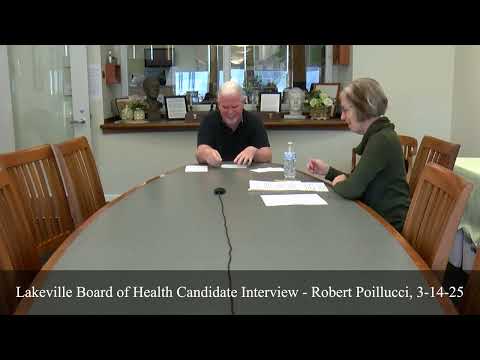
Bob Palucci, an incumbent member of the Town of Lakeville Board of Health and former board chair, said he is seeking re-election and emphasized the board’s role in septic permitting, well-water testing and shoreline protection during a candidate interview aired on Lake Ham.
Bob Palucci, an incumbent member of the Town of Lakeville Board of Health and former board chair, said he is seeking re-election and emphasized the board’s role in septic permitting, well-water testing and shoreline protection during a candidate interview aired on Lake Ham.
“The Board of Health’s job is to protect the lake, the groundwater, the aquifer, people's wells, to put as little nitrogen in the ground as possible,” Palucci said, summarizing the public-health priorities he cited in the interview.
Palucci framed his priorities around longstanding local issues. He noted his 15 years on the board, his experience responding to a major shoreline flood early in his term — which required on-site inspections and coordination with federal disaster officials — and the board’s use of state Title 5 requirements and “advanced treatment” denitrification systems for sensitive shorefront areas.
He said the board’s everyday work centers on septic permitting and inspections under Title 5, well-water testing, food-establishment inspections and mosquito and tick-borne disease information-sharing. Palucci described the board as active in approving systems for failing septic systems so homeowners can complete sales and avoid extended pump-and-wait cycles.
On planned growth, Palucci said proposed development of roughly “400 plus new apartments and homes” raises questions about school capacity and site-specific infrastructure rather than immediate groundwater contamination because such projects are subject to Title 5 and Department of Environmental Protection review. He said whether those projects connect to town water will determine local impacts, and he repeatedly described the expense of running new water lines as a barrier.
Palucci identified the Clark Shores Water Association as a pressing local concern: residents are “paying a lot of money and getting hardly no service,” he said, and the board has worked to help stabilize water access and costs for year-round shorefront homes that were not originally intended to be occupied year-round.
Questions about specific sites drew technical answers. On Rocky Woods, Palucci said ledge and poor percolation make on-site septic systems and municipal-water extensions costly; he said a community treatment plan could be permitted through the state but would require substantial blasting and utility work. “You’re gonna spend a lot of money blasting all the water and sewer lines,” he said.
On shared or community septic systems, Palucci said they can work when properly managed: “In theory, a condo association, if they have a good management company, they’re putting the money in the reserves accounts. They’re planning for that… and then they would have the money to go ahead and fix it.” He also cautioned that poorly managed systems become “a really big headache for the people.”
Palucci described the board’s internal procedures and review practices: plans typically are reviewed by the board’s agent and discussed at meetings; the board may approve proposals subject to additional inspections or conditions to avoid delaying homeowners. He said the board rarely grants variances for new construction and focuses most of its work on helping owners with failing systems achieve Title 5 compliance.
He defended board staff and volunteers, calling them “arguably some of the nicest people who ever worked in this town,” and said the board routinely works to accommodate time-sensitive closings by expediting reviews when possible. He also addressed public criticism on social media, saying he does not respond online but wanted to state he had been involved in building “12 of the units in town” and invited fact-checking of that figure.
On the open-space residential design (OSRD) zoning question, Palucci said cluster zoning can preserve open space without increasing total septic-related nitrogen load, but he criticized using an assumed high-density 40B proposal as the density baseline for cluster calculations. He added that density comparisons should be based on provable lot counts rather than speculative proposals.
The interview closed with Palucci urging voters to participate in the annual town election on Monday, April 7, at Loon Pond Lodge.
Palucci’s interview covered technical site constraints, ongoing enforcement of Title 5 standards, and the board’s role in helping homeowners manage failing septic systems and well-water concerns. He repeatedly emphasized denitrification and advanced-treatment systems for shorefront protection and cited both regulatory limits and practical cost constraints as determinants of townwide water policy.