Get Full Government Meeting Transcripts, Videos, & Alerts Forever!
Get email alerts on the Surveillance Technology topic
No spam. Unsubscribe anytime.
Cambridge council hears surveillance report; police say six overt cameras for Central Square due in April
Summary
The city presented its annual surveillance-technology report and discussed a planned pilot of overt cameras in Central Square. Residents urged audit or pause of police participation in regional intelligence databases and other surveillance tools.
The Cambridge City Council reviewed the city’s annual surveillance-technology report on March 17 and heard a mix of questions about specific programs — including ShotSpotter, automatic license-plate readers, regional intelligence sharing and a pilot of overt security cameras in Central Square.
City officials said the overt camera pilot is moving forward. Deputy Superintendent Michael Maderos told councilors that a vendor had been selected and that six overt cameras for Central Square were expected to be delivered and installed in April, though shipping delays had pushed schedules earlier in the month.
The annual report is an inventory of surveillance tools in use across city departments. Councilors and community groups used the meeting to press for stronger public review and transparency. Speakers and advocacy groups raised concerns about racial bias in gang and intelligence databases, the privacy risks of automated license-plate readers (ALPR), and the lack of detail the council had received when some tools were initially approved.
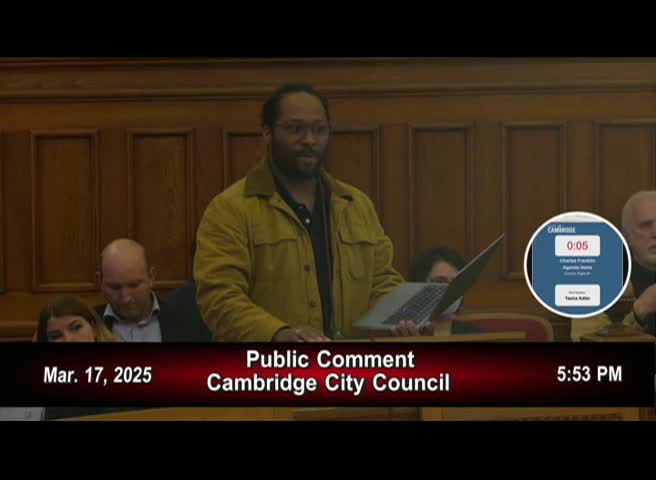
Tasha Adler of Digital Fourth and the Cambridge‑area civil liberties community asked that the Cambridge Police Department pause cooperation with the Boston Regional Intelligence Center (BRIC) until the city solicitor reviews BRIC entries concerning Cambridge residents. Adler said BRIC contains unverified reports that can subject people to increased scrutiny and that local review is needed to ensure compliance with privacy rules.
“Just to make sure that the records are based on a reasonable suspicion of involvement in an actual crime,” Adler said. She urged the council to require corrective action for non‑compliant records.
City solicitor Megan Baer explained that the surveillance ordinance sets out two required council processes: an annual report and a publicly released summary of Surveillance Technology Reports (STRs) filed by departments over the prior year. Baer said the annual report presented at the March 17 meeting satisfies the ordinance’s annual-report step; Baer and staff recommended the council adopt a second staff-prepared summary of the past year’s STR approvals before May 31 to finish the ordinance’s reporting requirement.
Several councilors moved and approved a request that the city manager prepare a summary report, to be returned before May 31, listing STRs submitted in the previous year and the council’s actions on them (approved, disapproved, or modified). Councilor Toner’s motion to have the city manager prepare that summary passed unanimously.
Deputy Superintendent Maderos said the Central Square cameras would be overt (visible) cameras, not covert, and that the department planned visible signage and public notice. He also said the vendor (BCM Controls) had assured the department the cameras should be ready for April installation after manufacturing and shipping delays. The cameras are being procured with Urban Area Security Initiative (UASI) funding, the department said.
Councilors asked for regular updates about how any new camera pilot or other tools affect privacy, response times and public safety. Councilors also discussed whether the council should take a public vote to adopt the staff-prepared summary of approved STRs. Solicitor Baer said the council must publicly release a summary that includes STRs approved during the previous year; Baer’s office and staff will draft the summary for council review and possible adoption.