Get Full Government Meeting Transcripts, Videos, & Alerts Forever!
Get email alerts on the Police Budget Firearms topic
No spam. Unsubscribe anytime.
Council delays vote on $570,000 police handgun purchase after hours of public opposition
Summary
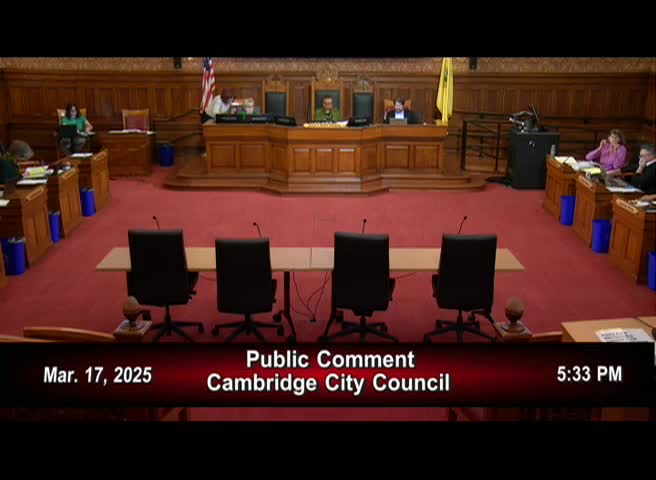
After hours of public comment opposing a city-manager request to replace police handguns, the Cambridge City Council voted to lay the $570,000 appropriation on the table and refer it to the Finance Committee for further review.
The Cambridge City Council on March 17 declined to approve a requested $570,000 appropriation for replacement handguns for the Cambridge Police Department, instead referring the item to the Finance Committee and laying it on the table.
Public opposition to the purchase dominated the meeting’s public-comment period, where dozens of residents and organizers urged the council to reject the measure and to instead fund community services such as the recently announced closure-impacted 58-bed Transitional Wellness Center.
City Manager Yan Wong’s request, listed as city manager’s agenda item number 7, sought to appropriate $570,000 from free cash to the police extraordinary expenditures account for replacement handguns. Police officials told councilors the department needs a uniform sidearm because the department’s current model, the SIG Sauer P320, was discontinued in 2022 and parts and new examples are increasingly unavailable. The department also said moving to the new firearm now would allow compatible holsters that interact with the department’s forthcoming body-worn camera rollout.
“Once they are here, once they are built, the company is gonna install them immediately,” Deputy Superintendent Michael Maderos said of a related camera purchase in a separate discussion. In remarks about the firearms, the department’s representative told the council that manufacturing lead time for the selected weapon would be approximately six months and that current training standards are changing in 2026, a factor the department cited to justify an accelerated timeline.
Dozens of speakers, many affiliated with local tenant and community groups, said replacing the guns now contradicted the city’s stated fiscal constraints and public-safety priorities. “I do not support the city manager’s request for almost $600,000 to upgrade and replace all of the guns in the police department,” said Dan Totten, a Cambridge resident. Speakers named recent local uses of force and surveillance programs when urging the council to pause the appropriation and redirect money to housing or services.
Police leaders said the department has limited spare inventory of the current models and several new officers are entering service; they described safety and training risks if the department exhausts usable weapons or spare parts. “It is important that the department personnel are all trained on the same firearm to ensure safety and interoperability,” the commissioner said, adding that compatible holsters would trigger body-worn cameras when an officer draws a weapon.
Councilors split over how to proceed. Councilor Toner moved to suspend the rules and bring related police items forward for discussion; later a motion to lay the appropriation on the table and refer it to the Council’s Finance Committee carried on a roll call of 7 in favor, 2 opposed (Councilor Toner and Mayor Simmons recorded as voting no). That vote means the council did not appropriate funds for the purchase at the March 17 meeting; Finance Committee review is expected before a final council decision.
The debate highlighted several factual disputes raised during public comment: speakers said the department’s procurement papers indicated many of the current handguns were acquired in 2020 (roughly five years ago) and some callers to the manufacturer’s law-enforcement office said the P320 “carry” model was still available. Police officials and department training staff maintained they are facing supply and parts limitations and pointed to operational and training reasons for replacing the fleet.
Councilors and staff also discussed other procurement questions, including whether part of the requested sum reflects trade‑in value for existing weapons and whether some replacement could be handled within the police operating budget instead of drawing on reserves. City finance staff said the $570,000 request includes offsets for trade-ins and a separate line for training firearms; they described the request as a one-time capital-style expenditure rather than an ongoing operating cost.
The referral to Finance allows members extra time to examine procurement bids, trade-in values, the department’s inventory and training schedule, and to weigh capital timing against other city priorities. If the Finance Committee or council requests more information, city staff and police leaders said they would supply it before any final appropriation vote.
For now, the appropriation remains unresolved. The council’s decision to refer and table the request leaves the department operating under its current inventory while the city reviews options and documentation requested by councilors and committee members.