Get Full Government Meeting Transcripts, Videos, & Alerts Forever!
Get email alerts on the Renewable Energy topic
No spam. Unsubscribe anytime.
Skagit Valley Clean Energy outlines Solarize Skagit 2025 campaign, urges residents to enroll before net-metering change
Summary
Skagit Valley Clean Energy Alliance briefed commissioners on Solarize Skagit 2025, a time-limited group-purchase program offering pre-vetted installers, a $2.45-per-watt group rate, financing options and federal tax credits. Presenters emphasized 2025 as a critical year before statewide net-metering changes.
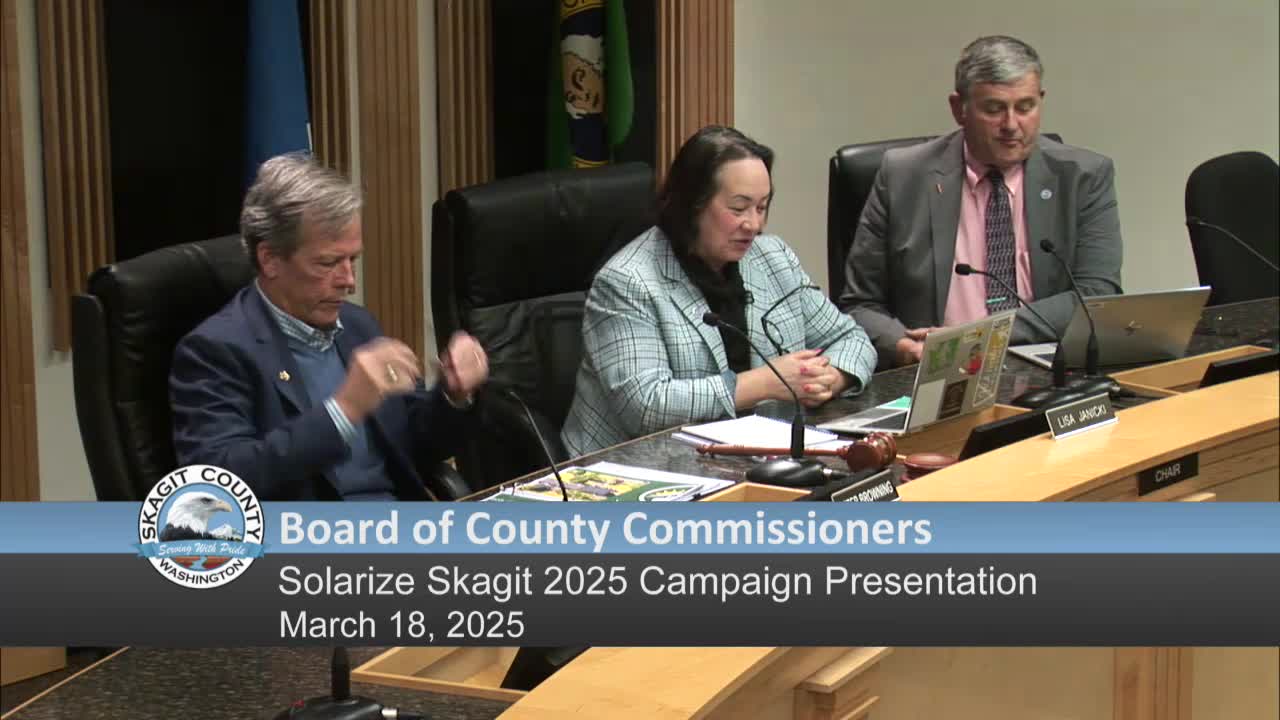
Skagit Valley Clean Energy Alliance presented Solarize Skagit 2025 to the Board of County Commissioners on Tuesday, describing a time-limited group-purchasing program that pairs residents with pre-vetted installers, reduced equipment pricing and financing options.
"This is our third year for Solarize Skagit," the presenter identified as Mary said, describing the program as "a time limited group purchasing program to bring solar to Skagitonians at a reduced cost with pre vetted solar installers." Mary said the campaign is run by the local nonprofit (a 501(c)(3)) in partnership with Olympic Community Solar and two selected installers for Skagit County: Western Solar and Truly Electric.
Presenters explained why 2025 is a critical year for residents considering rooftop solar. Mary said the current retail-style net-metering arrangement'1-to-1 credit for exported energy'is scheduled to sunset at the end of the year, and customers who enroll and install in 2025 will be grandfathered under the existing net-metering rules. "Currently, the net metering is 1 kilowatt, banked to 1 kilowatt used. It's a 1 to 1 ratio. Well, that's going to go away," Mary said.
Mary summarized pricing and payback examples using a model home: a typical 1,700-square-foot Skagit County home using about 13,200 kilowatt-hours per year would need roughly a 12-kilowatt system. At the Solarize campaign's negotiated 2025 group rate of $2.45 per watt, she estimated a system cost around $29,400 before the 30% federal investment tax credit, yielding a conservative payback of about 12.6 years in her example.
The campaign offers optional battery backup, Level 2 EV chargers and home energy audits. Mary said the campaign secured "made in Washington" panels (Silfab) and is working with Puget Sound Cooperative Credit Union on reduced-rate loans. She reported growth from previous years: in 2023 Solarize sign-ups in Skagit County yielded 9 installations and 95.68 kilowatts; 2024 saw 17 installations and 55.27 kilowatts. The 2025 goal is 50 installations.
Commissioners asked about panel warranties, degradation and financing terms. Greg Whiting, identified as the program's technical expert, said most modern panels carry long warranties and degrade roughly 1% per year; he and Mary noted installers warrant equipment and performance details vary by manufacturer. The presenters said financing was newly available and could stretch payments over multiple years to improve cash-flow, though exact loan term lengths were not specified during the presentation.
Mary requested assistance from county channels to promote the campaign and provided a timeline: outreach March'July for enrollment, a public kickoff event set for April 12 in La Conner, and installations continuing through year-end.
The presentation included technical background on how net metering and banked credits work, and the presenters encouraged interested residents to enroll this year to preserve current net-metering terms.
No county financial commitment or vote was taken; the session was informational. Commissioners expressed support for outreach assistance and asked staff to coordinate any county communications that could help reach residents.