Get Full Government Meeting Transcripts, Videos, & Alerts Forever!
Get email alerts on the Water Supply topic
No spam. Unsubscribe anytime.
Midland officials debrief water outage; point to valve failure, treatment‑plant reductions and zebra mussels
Summary
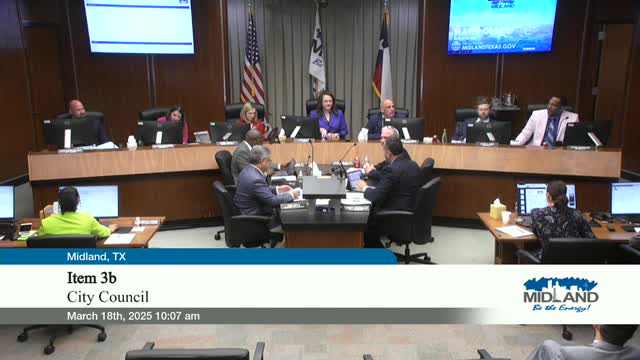
City staff briefed the Midland City Council on March 18 on a late‑February/early‑March water event that reduced treated water capacity and led to low pressure in parts of west Midland.
City staff briefed the Midland City Council on March 18 on a late‑February/early‑March water event that reduced treated water capacity and led to low pressure in parts of west Midland.
Tommy (staff member) said the outage was caused by a “perfect storm” of operational problems: two of the treatment plant’s four trains were offline for repairs, a city‑limit valve on FM 158 was not functioning correctly, and the regional supplier was managing zebra‑mussel treatment and maintenance that limited reservoir and supply availability. “We fell short that day,” Tommy said, taking responsibility for operational and communication failings.
Why it matters: Midland relies on a mix of Colorado River Municipal Water District (CRMWD) surface supplies and two local groundwater sources. The city’s North Midland Water Treatment Facility can treat up to 32 million gallons a day (MGD) across four “trains” (about 8 MGD each); two trains being down cut available treated capacity substantially and, combined with the valve problem at a critical transmission point, produced low pressures concentrated on the west side of the city.
Tommy and water staff described the sequence of failures: contractors had taken two trains offline for zebra‑mussel related repairs; a separate contractor repair damaged electrical controls and extended downtime; and a city valve on FM 158 that regulates flow and pressure was not fully functioning. The valve’s internal parts had been repaired, Tommy said, but the full replacement unit won’t arrive until May. Staff estimated that the failed valve model would cost about $40,000 if kept on hand but noted specialized parts age and degrade in storage, making “shelf stock” of some proprietary items impractical.
Staff explained backup supplies and storage: CRMWD normally provides about 17.5 MGD under a take‑or‑pay contract; the T Bar Ranch groundwater facility can supply up to 20 MGD but typically delivers 10–12 MGD; the treatment plant has clear‑well storage (about 13 M gallons usable) and adjacent raw‑water inventory (about 15 M gallons needing treatment). “Peggy Sue,” a remote storage basin, can hold 95 M gallons but was reported at roughly 10 M gallons after CRMWD maintenance and was therefore unavailable as usable capacity during the event.
Zebra mussels and treatment: staff said the mussel infestation was first identified in 2019 at Lake Ivy and that CRMWD and the city treated reservoirs with copper sulfate beginning in late 2023. Zebra‑mussel larvae increase turbidity and can force treatment units offline. Staff said TCEQ (Texas Commission on Environmental Quality) reviewed and confirmed the safety of the drinking water during the event; city staff emphasized that the city did not issue a boil‑water notice.
Near‑term and medium‑term actions: council heard a list of steps already taken and planned, including - a prioritized valve‑maintenance program to identify and maintain “critical” valves first; - installation of automated sensors and leak‑detection technology (IT work ~70% complete at time of presentation) to monitor flow and pipe condition; - formalized after‑action reviews and exercises so staff do not “atrophy” on response protocols; - consideration of bypass lines and additional redundancy from Paul Davis Wellfield (advanced treatment) and other supply agreements; and - negotiation efforts with CRMWD to rework the take‑or‑pay contract and its force‑majeure terms (full renegotiation not scheduled until 2029, staff said).
Council members and the mayor praised staff and outside partners for around‑the‑clock response and mutual aid from nearby communities and energy companies. Councilman Burkholder asked why the west side was hit harder; staff attributed it to the hydraulic configuration — elevation and the location of the failing valve and reduced treatment capacity.
What remains unresolved: staff flagged implementation and procurement hurdles — some specialized components cannot practically be stocked and require agreements with distributors or fabricators to expedite delivery. Council asked whether to replace the valve immediately when parts arrive or delay until fall; staff said a formal risk analysis would inform that choice.
Context and next steps: Tommy said the city has initiated an internal water committee and plans an external advisory group including industry partners and outside engineering expertise. Staff also plans to bring targeted items to council (procurements, agreements for bypass lines and sensors) and to update the community publicly as work proceeds.
Ending: Council committed support for additional resources and follow‑up work. Staff said the May arrival of critical parts and planned sensor automation are near‑term milestones; longer‑term actions include infrastructure upgrades and additional treatment capacity or partnerships to increase redundancy.