Get Full Government Meeting Transcripts, Videos, & Alerts Forever!
Get email alerts on the Legislation Roundup topic
No spam. Unsubscribe anytime.
Health and Government Operations Committee hears sponsor presentations on veterans notation, licensure and procurement bills
Summary
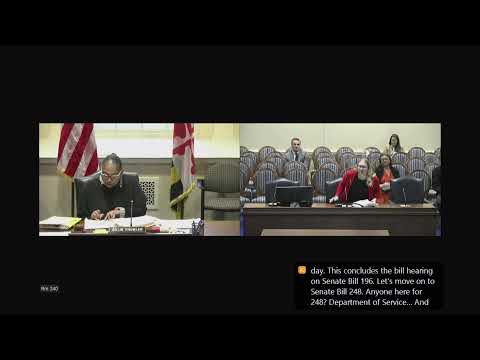
At a hearing of the House Health and Government Operations Committee (date not specified), committee members heard sponsor presentations on a series of Senate bills addressing veteran status notation on government identification and professional licenses, changes to health occupation boards, procurement and agency rulemaking authority.
At a hearing of the House Health and Government Operations Committee (date not specified), committee members heard sponsor presentations on a series of Senate bills addressing veteran status notation on government identification and professional licenses, changes to health occupation boards, procurement and state leasing rules, emergency management regulatory authority and other technical updates.
Committee Chair Jocelyn Pena Melnick opened the session and said the panel would take testimony only from sponsors or designated witnesses for Senate bills that are cross-filed with House versions; where a bill has no cross-file, the committee would hear the sponsor and up to one witness in favor and one opposed.
Why it matters: Several of the bills would make it easier for veterans to show eligibility for state services and benefits by allowing an optional veteran notation on state-issued identification and certain professional licenses; others were described as technical or housekeeping changes to state boards, procurement procedures and agency rulemaking authority. Sponsors repeatedly asked the committee for a favorable report and said many measures had already passed the other chamber in identical form.
Veteran notation and related measures
Two bills focused on adding an optional veteran notation to state-issued IDs or to professional license records. Senator Simon (presenting as "Senator Simon Ayers" in the hearing) described Senate Bill 48 as an optional program that would let state general services ID cards show veteran status; he said the Department of General Services and the Department of Veterans and Military Families support the change, that there was no fiscal note and that the program would mirror similar notations now offered on driver’s licenses in other states. Dave Dragic, retired Army colonel and legislative director for the Maryland Military Coalition, testified the Maryland Military Coalition “strongly support[s]” SB 48 and said a notation would reduce the burden on veterans seeking state or federal benefits by reducing the need to repeatedly prove eligibility.
Senate Bill 67 would permit health occupations boards to include a veteran notation on public license profiles and on certain license records, potentially covering “up to 400,000 licenses” according to the sponsor’s presentation. Sponsor testimony described the change as optional, consent-based and intended to help veterans access services and connect to outreach from the Department of Veterans and Military Families.
Sponsors cited outreach and suicide-prevention rationale for veteran-notification measures. Senator Simon commented that outreach and recognition can help with isolation and noted a national statistic cited in the hearing that “18 to 21 veterans” die by suicide per day; the bill sponsors framed notation as a way to increase peer contact and awareness of services.
Service-animal and veterans’ program changes
Senate Bill 182 would expand the Maryland Veterans Service Animal Program to include family members of veterans and align program references with the department’s current name, the Department of Veterans and Military Families. The sponsor said the program began in 2017, has operated without a fiscal impact for this change, and that the department supports the amendment.
Procurement, leases, forms and electronic transaction bills
Multiple sponsors told the committee their bills were identical to House versions and asked for favorable reports on bills that address procurement, state leases and forms management. John Willems of the Department of General Services summarized two bills: one (SB 194) to adjust how the state advertises and makes available leases of real property (with committee-developed amendments to preserve local newspaper publication requirements) and another (SB 260) to remove redundant reporting requirements tied to the state’s forms-management reforms.
Senate Bill 196 (procurement electronic transactions clarifications) and a related bill addressing fees were presented in the same posture as passed House measures; the presenters told the committee these were technical clarifications and asked for favorable consideration.
Health occupations and professional boards
Several bills before the committee update professional licensing and board procedures. Sponsors described SB 52 (State Board of Chiropractic Examiners revisions), SB 72 (a health-occupations measure to allow English-proficiency determinations from other states to transfer for licensure by endorsement in nursing), and SB 47 (State Board of Physical Therapy Examiners revisions) as identical to House bills that already received favorable reports. Senator Clarence Lam presented SB 72 as an endorsement/reciprocity clarification for nursing licenses.
Emergency management and 9-1-1
Senate Bill 138 would give the Maryland Department of Emergency Management (MDEM) regulatory authority the sponsor said it lacked when created; the sponsor described the bill as allowing MDEM to promulgate its own regulations. Senator Kagan, who presented this measure, told the committee the bill passed both chambers unanimously. Senator Kagan also presented SB 36, a narrowly tailored adjustment to connect the state’s suicide and crisis hotline system to a broader set of services while preserving statutory privacy and lockbox protections.
Other bills and technical updates
The hearing included a range of sponsor-only and technical bills presented with little debate: SB 296 (Public Information Act — public access ombudsman delegation of powers), SB 85 (a memorial/flag act cross-filed with a House bill), SB 172 (adding the Department of Disabilities as a member to the Maryland Veterans Trust Board of Trustees), and a Senate measure updating the name from "Maryland State Fireman’s Association" to "Maryland State Firefighters Association." Presenters repeatedly said these bills had passed in similar form in the other chamber and asked for favorable reports.
Committee process and questions
Committee members asked occasional procedural and fiscal questions. For SB 248 (Department of Service and Civic Innovation — program/pathway revisions), staff said the bill requested flexibility in how existing appropriated funds are used across program pathways and that the $20,000,000 cited in the fiscal note represented existing appropriations rather than a new appropriation. The sponsor and agency witness told the committee the bill would not add funding but would permit greater flexibility in spending already-appropriated money.
No committee votes or final actions on the bills were recorded in the hearing transcript; most presenters concluded by asking the committee for a favorable report and noted the bills were "in the same posture" as identical House measures already considered by the committee.
Quotes
"The Maryland Military Coalition strongly supports SB 48," said Dave Dragic, retired Army colonel and legislative director for the Maryland Military Coalition, adding that notation would reduce the administrative burden on veterans seeking benefits.
"This bill does not ask for additional money — it is asking for flexibility of the funding we already receive," an agency witness said during questions about program funding for SB 248.
What’s next
Sponsors asked the committee for favorable reports; the transcript records sponsor presentations and limited committee questioning but no recorded committee votes or formal actions. The bills will remain before the committee for further consideration according to the committee’s regular process.