Get Full Government Meeting Transcripts, Videos, & Alerts Forever!
Get email alerts on the Workforce And Community Bills topic
No spam. Unsubscribe anytime.
House workforce committee lays over nursing home, community and career-pathway bills for later budget action
Summary
The House Workforce, Labor and Economic Development Finance and Policy Committee on Thursday heard testimony on six workforce and community bills and laid them over for possible inclusion in a later budget bill.
The House Workforce, Labor and Economic Development Finance and Policy Committee on Thursday heard presentations and testimony on six bills addressing nursing home worker training and definitions, two West Broadway (North Minneapolis) community business and youth workforce proposals, and three workforce-education/apprenticeship pathway programs. Committee co-chairs Representative Dave Pinto and Chair Dave Baker presided; the committee laid all six bills over for possible inclusion in a later budget bill rather than advancing any to an immediate vote.
Why it matters: The bills cover worker training tied to recently adopted nursing home workforce standards, technical fixes to the standards' scope, neighborhood economic development and youth employment programs in North Minneapolis, and several statewide career-pathway programs (construction trades and operating engineers) that aim to funnel young people, veterans and other underrepresented groups into apprenticeships and family-sustaining careers. Several members said the measures intersect with larger budget choices and federal funding questions that will determine how much the state can sustain via appropriations.
The bills and key points
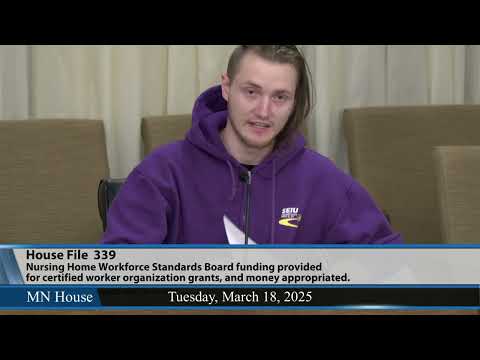
House File 339 (Nursing Home Workforce Standards Board—training funds) Representative [author identified in transcript as Representative Ekbaje/Bauge] presented HF 339, which would appropriate $1,000,000 in one-time funding for the upcoming biennium to reimburse certified worker organizations that provide the statutorily required training for nursing home workers about their rights under the Nursing Home Workforce Standards Board. Testimony came from Travis Birth, a nursing home worker and union representative with SEIU Healthcare Minnesota & Iowa, who said the training is needed so workers know how to enforce rules such as holiday time-and-a-half and the industry minimum wage rule that is contingent on legislative funding. Committee members questioned whether nonunion trainers and provider organizations could meet board certification criteria; the bill’s author said the board will set and apply objective criteria and any organization that meets them would be eligible. The chair laid HF 339 over for possible inclusion in a future budget bill.
House File 1272 (technical clarification to Nursing Home Workforce Standards Board scope) HF 1272 was described as a technical bill intended to narrow and clarify which facilities fall under the nursing home employer definitions used by the board, aligning statutory language with how the Department of Labor and Industry has implemented the law. The sponsor said the clarification would exclude certain facilities from the board’s scope, including veterans homes, private-pay-only facilities, facilities on tribal land and Medicare-only rehabilitation nursing homes, because they are not reimbursed under Medicaid and therefore were not intended to be covered. The Department of Labor and Industry Legislative Director told the committee the department supports the technical change. The chair laid the bill over.
House File 2121 (West Broadway Coalition ambassador program) Representative [author identified in transcript as Representative Berg/Bauge] introduced HF 2121, a funding request to support the West Broadway Business and Area Coalition’s ambassador program in North Minneapolis. Testifiers Crystal Porter (executive director) and Donna Sanders (business specialist) described the program’s work—litter removal, planter installation, visible uniformed ambassadors who assist youth and the public, and second-chance job opportunities—and said their Special Service District assessment base generates about $200,000 annually for 27 blocks, so supplemental funding and partnerships have been necessary. Committee members asked about city funding and possible competitive grant approaches; testifiers and the sponsor said they welcome options that sustain the program. The bill was laid over.
House File 2122 (West Broadway youth internship program) HF 2122 would establish and fund a youth internship program in North Minneapolis, connecting high-school-aged interns (reported in testimony as roughly 10th grade and above) with local businesses, employers such as North Memorial, and job-training partners. Testimony highlighted local nonprofit success stories (Cookie Cart and Appetite for Change) and cited research on the positive effects of youth employment programs. Committee members noted overlap with other youth development grants and suggested coordinating across programs and competitive grant opportunities; the bill was laid over.
House File 1216 (Building Strong Communities—apprenticeship readiness) Representative Berg presented HF 1216 to continue funding a 12-week statewide apprenticeship-readiness program called Building Strong Communities. Testimony from the program’s executive director and multiple graduates described a combination of virtual instruction, hands-on training in multiple Minnesota regions, OSHA and foundational construction curriculum, mentorship and year-long advocate follow-up. Speakers said enrollment has grown (from 43 to 127 participants between 2022 and 2025 on the program’s materials), that participants earn college credits and that the program focuses on people without family trades backgrounds, including women and veterans. Members asked how the program complements other workforce initiatives; sponsors said Building Strong Communities centralizes best practices and post-placement support. The bill was laid over.
House File 1003 (Operating Engineers career pathways) Representative Schultz presented HF 1003 to appropriate $500,000 from the state workforce development account to support operating-engineers career-pathway classes for high school students. Testimony from Local 49 and multiple district representatives described a statewide virtual-enrollment approach paired with hands-on “sandbox” events and in-person pilots (examples: Wright Technical Center and a planned St. Paul site) and noted participation from more than 150 school districts and hundreds of enrollments. Committee members asked about capacity, reimbursement to districts and broadband access for virtual students; sponsors said districts are reimbursed when students pass the course and that pathway events and career navigators help connect successful participants to apprenticeship entry. The bill was laid over.
Committee process and next steps Committee co-chairs said the plan for the hearing was to formally hear and lay the bills over for possible inclusion in the larger budget process; none of the bills were advanced to a committee vote during the session recorded in the transcript. Members repeatedly framed their questions in budgetary terms—whether programs should be funded directly or via competitive grants, how state budget caps or federal funding changes could affect long-term program viability, and how the committee’s role intersects with K–12, higher education and other workforce investments. Chairs Pinto and Baker said they will continue conversations and consider how to align these proposals with larger budget and competitive-grant approaches. No final dates for further action on the specific bills were set in the transcript.
Ending note: Several members and testifiers urged attention to program design details—who can be an approved trainer under the nursing-home training requirement, whether special service-district assessments and city funds are sufficient for neighborhood maintenance, and how pathway programs overlap—suggesting more technical follow-up and report documents will be helpful as the committee weighs inclusion in the upcoming budget cycle.