Get Full Government Meeting Transcripts, Videos, & Alerts Forever!
Get email alerts on the Public Broadcasting topic
No spam. Unsubscribe anytime.
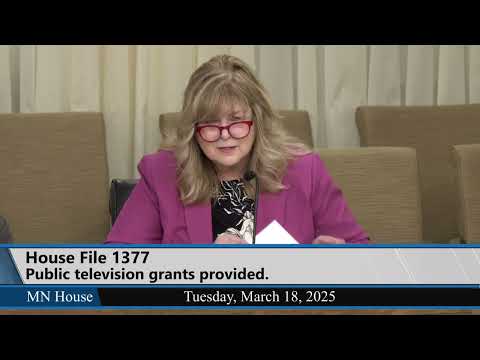
Committee hears testimony on funding increase for Minnesota public television; House File 1377 laid over
Summary
Witnesses from Minnesota public television urged the committee to increase block and matching grants that support regional nonprofit stations; House File 1377 was laid over for possible inclusion after testimony.
Legislators and representatives of Minnesota Public Television Association told the State Government Finance and Policy Committee on March 18 that state operating and matching grants are essential to keep public television’s educational and regional services available across Minnesota.
Representative Anderson moved House File 13‑77 to come before the committee and the bill was laid over for possible inclusion. Les Heen, representing the Minnesota Public Television Association, described Minnesota’s public television system as six regional nonprofit, community‑licensed stations rather than a single statewide entity. “We have 6 regional nonprofits and they’re all community licensees,” Heen said, noting local governance and community‑tailored programming.
Patty Mester, general manager of PBS North in Duluth and president of the Minnesota Public Television Association, said about one‑third of primary channel daily schedules remain devoted to noncommercial children’s education and that in some rural areas roughly 55 percent of children do not attend preschool. Mester said state grants are matching: “By law, these grants must be matched with funds from Minnesota‑based contributors,” and that matching and block grants support equipment, utilities and operations.
Mester emphasized the mix of services public television provides — early‑learning content, classroom use by teachers (she said more than 20 percent of Minnesota teachers use station content), public affairs and emergency broadcasting — and framed state grants as reinvestments into local communities. Committee members including Representative Anderson and Co‑chair Cleavern expressed personal support and bipartisan interest. The committee laid House File 13‑77 over for possible inclusion; the transcript records no formal vote on an appropriation in committee.