Get Full Government Meeting Transcripts, Videos, & Alerts Forever!
Get email alerts on the Cannabis Policy topic
No spam. Unsubscribe anytime.
Committee lays over several cannabis bills as Office of Cannabis Management seeks grant-timing, testing and equity changes
Summary
The Office of Cannabis Management described four modest budget and implementation requests on March 18, and the Senate Commerce and Consumer Protection Committee approved author amendments and laid over multiple cannabis-related bills for further consideration.
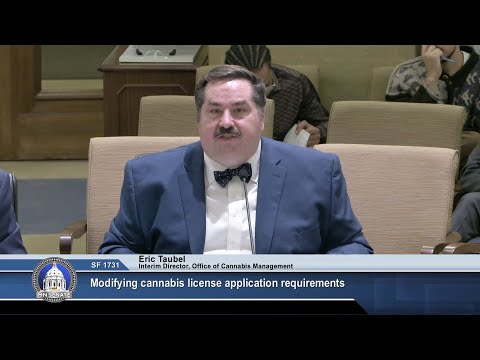
Eric Taubel, interim director of the Office of Cannabis Management, told the Senate Commerce and Consumer Protection Committee on March 18 that the office seeks four relatively small budget and implementation changes and that a package of cannabis-policy bills before the committee largely contain technical fixes and clarifications.
Taubel introduced the office's four requests: an operating adjustment to cover rising labor, insurance, space and technology costs; an extension of the CanRenew grant expenditure deadline; a variance to the current ISO-certification requirement for testing facility licenses; and an adjustment to the social equity verification criteria to account for people whose adjudications were stayed or adjudicated in juvenile court and therefore do not produce convictions for verification purposes.
"We are currently in the RFP process for the first year of the CanRenew grant that closes on March 24," Taubel said. He described the requested extension as intended to allow awarded grantees sufficient time to complete their agreements if they are not yet ready in the current biennium. On laboratory requirements, Taubel said the ISO certification requirement presents a barrier to entry and that the office is willing to cover some of the certification cost to accelerate market testing capacity while ensuring products are safe. On equity, he said the change is responsive to feedback that those with juvenile adjudications or stays of adjudication were effectively excluded from social-equity verification despite experiencing similar justice impacts.
Several separate bills addressing adult-use, medical and hemp-derived products followed in committee discussion. Senator Wicklund moved that Senate File 2371, as amended, be recommended to pass and be referred to the Committee on Health and Human Services; the chair called the voice vote in the affirmative and the motion carried with no roll-call tally recorded. Other bills discussed included Senate Files 17-29 (licensure and regulation of lower-potency hemp edible products), 17-30 (defining the Office of Cannabis Management as a state agency for Minnesota Indian Affairs Council participation), 17-31 (application requirements and consolidation of attestation requirements) and 2,372 (housekeeping and technical fixes aligning chapter 152 and chapter 342 and aligning medical program authority). On several of these bills the committee adopted author's A1 amendments by voice vote (Senators Prince, Seaburger and Wicklund offered A1 amendments at different points) and then laid the bills over for further consideration.
Committee members asked some procedural questions about why sponsors introduced multiple separate bills instead of a single omnibus measure; Senator West and Senator Est expressed discomfort with the approach but did not block action. Director Taubel and Senator Dibble said the bills had been divided topically to accommodate authorship and stakeholder interests.
Committee action: The committee adopted a series of A1 author's amendments by voice vote and laid over the cannabis bills discussed. Senator Wicklund successfully moved that Senate File 2371 be recommended to pass and referred to Health and Human Services. Several other files were laid over; the committee did not enact final passage on any adult-use or medical cannabis bill at the hearing.