Get Full Government Meeting Transcripts, Videos, & Alerts Forever!
Get email alerts on the Large Scale Development topic
No spam. Unsubscribe anytime.
Committee hears pitch for $44.66 million in state bonds for The Heights redevelopment in St. Paul
Summary
Senate File 2644 requests $44.66 million in housing infrastructure bonds to complete the Heights redevelopment on the former Hillcrest Golf Course in Saint Paul, a 112-acre project planned for 1,000 housing units and 1,000 jobs; the bill was laid over for possible inclusion.
Senate File 2644, presented to the Minnesota Senate Committee on Housing and Homelessness Prevention, requests $44,660,000 in housing infrastructure bonds to fund the public portion of The Heights development, a redevelopment of the former Hillcrest Golf Course on Saint Paul’s East Side.
Senator Hurd, the bill’s sponsor, described the request as “the last 8 percent of the financing package” for a project that will provide 1,000 housing units and 1,000 living‑wage jobs on a 112‑acre site. Mayor Melvin Carter, representing the City of Saint Paul, said the Saint Paul Port Authority purchased the site in 2019 and that the city adopted a Hillcrest master plan in 2022. Carter emphasized the project’s scale and sustainability features, including a large district geothermal system intended to lower energy costs for residents.
Todd Hurley, president and CEO of the Saint Paul Port Authority, said grading and environmental remediation of the former golf course were completed in 2024 and that roads and utilities will be finished by the end of the 2025 construction season. He reported that the first industrial partner (an Xcel Energy service center) had broken ground and that the first housing units—including a Habitat for Humanity build—are under construction.
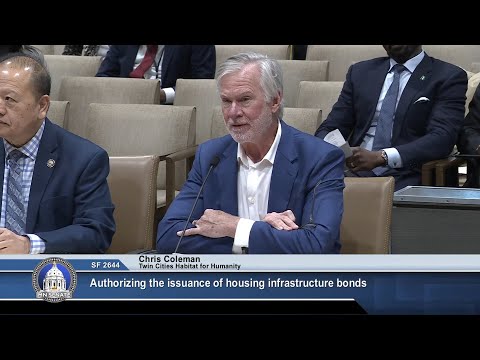
Housing developers and partners told the committee the site will include a mix of ownership and rental options across income levels, with long‑term affordability covenants tied to federal Low Income Housing Tax Credit and municipal TIF requirements. Chris Coleman, president and CEO of Twin Cities Habitat for Humanity, said Habitat plans 47 homes on the site. Chris Sherman of Sherman Associates said more than half the units will be targeted at or below 60 percent of area median income; he said at least 10 percent of units will serve households at or below 30 percent AMI and that 104 units will be three‑bedroom homes for larger families. Sherman said the total Heights investment is roughly $700 million and characterized the state request as representing about 8 percent of the project cost.
Developers described financing sources including private, federal, county and local dollars, tax increment financing approved by the city, project‑based vouchers recommended by Saint Paul Public Housing Authority, and local contributions. Sherman said the requested state contribution averages under $50,000 per home and would leverage more than $675 million in other funds.
Senators asked about long‑term affordability protections and ownership structure; Mayor Carter and developers said the city and its partners are working with housing organizations including Habitat for Humanity and that selection of development partners and contract terms are important to ensure long‑term affordability and project quality. No formal committee vote was recorded; the bill was laid over for possible inclusion in an omnibus package.