Get Full Government Meeting Transcripts, Videos, & Alerts Forever!
Get email alerts on the State Legislation topic
No spam. Unsubscribe anytime.
San Antonio committee hears state legislative roundup; staff flags bills on cybersecurity, annexation, zoning and military bases
Summary
City governmental affairs staff updated the Intergovernmental Relations Committee on dozens of Texas bills that could affect San Antonio services, land use and military facilities; committee members asked for focused briefings and staff approved meeting minutes unanimously.
San Antonio governmental affairs staff gave the city's Intergovernmental Relations Committee an overview of dozens of bills pending in the Texas Legislature that staff say could affect annexation, emergency-service financing, zoning rules, municipal regulation near military bases and a new University of Texas cybersecurity command.
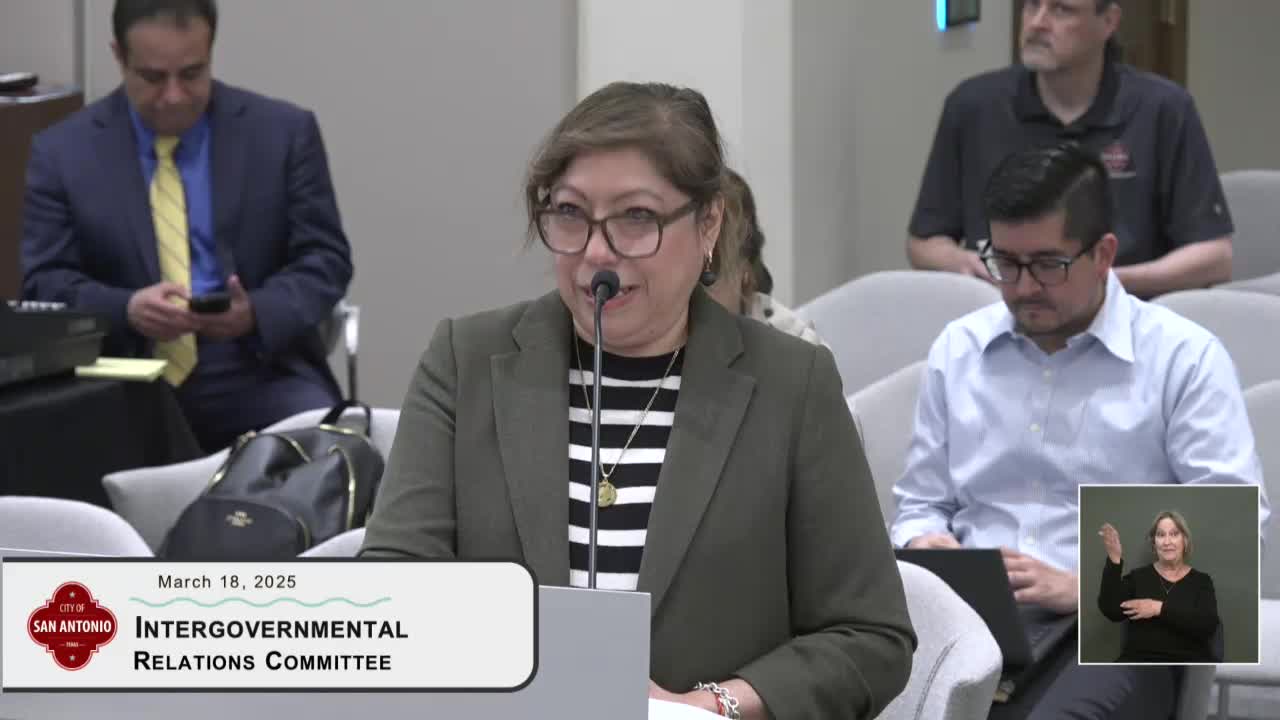
Sally Bazurto, director of governmental affairs, told the committee the legislative session began Jan. 14 and that staff have been tracking thousands of measures. "My team has identified more than 5,000 bill proposals that will be reviewed, analyzed and shared with city counterparts to determine impacts to the City of San Antonio," Bazurto said during the committee meeting. She added that the office will publish weekly updates on the city's website.
Bazurto highlighted a bill the presentation identified as "HB 150," which the city described as establishing a cybersecurity command within the University of Texas system to lead statewide cyber incident response, coordinate with government partners and develop education and workforce programs. The committee was told the city is working closely with UTSA and other partners to understand the proposal and whether to support it.
Staff also flagged multiple bills the presentation said could affect San Antonio operations or residents. Items discussed include: measures the presentation identified as SB 15 and related proposals that, according to staff, would limit municipal ability to require service agreements prior to annexation and could leave residents liable for duplicate emergency-service bills; a proposal the presentation identified numerically as 1509 that staff said would restrict municipal regulation of land uses near military installations and could affect operations at San Antonio bases; and a set of zoning-related bills (presentation cites a bill by "Campbell," another by "Middleton," and one allowing mixed use on land owned by religious institutions) that staff said would expand who can be notified or protest rezoning and could change development review procedures.
Committee members asked staff for concise summaries and local impact analysis. Councilmember Villagre1n asked specifically about minimum lot-size changes and how the bills would affect development of small-lot or multifamily projects. Bazurto replied that the presentation shows a comparison of existing local rules with proposed limits (the presentation references a 4,000-square-foot figure and a possible statewide limit near "1,400" square feet); Bazurto said staff would investigate the specific density impacts and return with more detailed analysis.
Bazurto said the office has opposed at least one proposal cited in the presentation (SB 15 as described in the slide materials) and has been negotiating with authors and legislative offices where possible. She also summarized several bills about timing and voter approval for local bonds and tax-increase elections; those bills would, as presented, limit some local elections to uniform November dates and change voter-approval thresholds for bond measures.
Committee members asked that future materials be shorter and emphasize the highest-priority measures. Bazurto said the weekly updates will include a short-form list of positions the city is supporting or opposing for that week and that staff expect the tracked list to change as committees take up bills.
At the end of the meeting the committee approved a motion to adopt meeting minutes; the transcript records the vote as unanimous. The motion and roll-call details were not read into the record.