Get Full Government Meeting Transcripts, Videos, & Alerts Forever!
Get email alerts on the State Legislation topic
No spam. Unsubscribe anytime.
San Antonio committee tracks fast-moving Texas cyber command bill and flags annexation, zoning measures
Summary
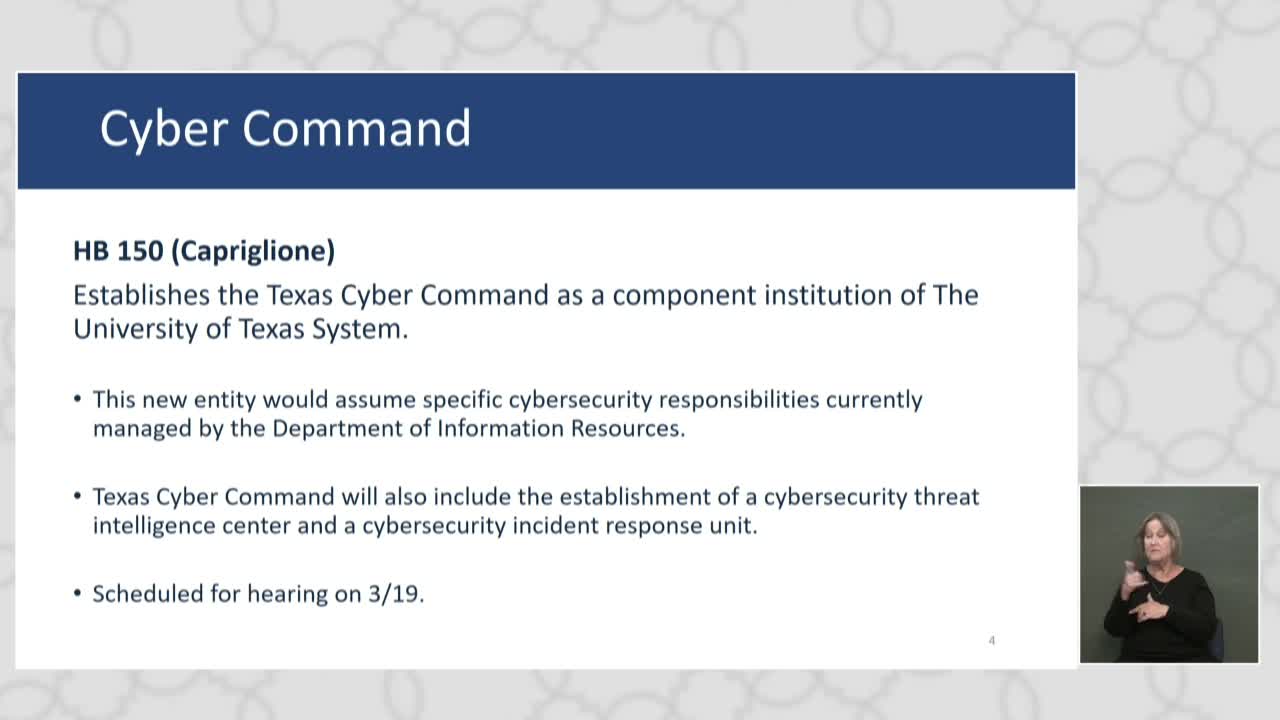
City of San Antonio staff on Tuesday told the Intergovernmental Relations Committee they are monitoring a surge of bills in the 89th Texas Legislature and urged the council to watch a quickly moving proposal to establish a state "cyber command."
City of San Antonio staff on Tuesday told the Intergovernmental Relations Committee they are monitoring a surge of bills in the 89th Texas Legislature and urged the council to watch a quickly moving proposal to establish a state "cyber command." Sally Basurto, director for government affairs, told the committee the bill would create a cyber command under the University of Texas system and include a threat intelligence center, an incident response unit, policy development, and workforce training.
"The cyber command bill dropped, last week on March 11, and it is moving, quickly," Basurto said, adding the initiative would "assume specific cybersecurity responsibilities currently managed by the Department of Information Resources." She said the city is coordinating with UTSA and other partners to support San Antonio's interests.
The briefing placed the cyber command proposal at the top of an extensive list of legislative items the city's Government Affairs team is tracking. Basurto said the team is reviewing several hundred bills and expects the tally of tracked measures affecting city operations to grow from roughly 1,000 to 1,400 as filings are analyzed and departmental impacts assessed.
Why it matters: The committee was told the cyber command would focus on critical infrastructure including energy, communications, healthcare and public-safety networks and could shift responsibilities and resources currently held at the state level.
Basurto also outlined bills the city opposes or is watching closely. She said the city opposed HB 23 (by Rep. Harris), which would allow applicants to seek third-party reviews of development documents and building inspections — a change Basurto described as bypassing the city's review authority. "Obviously, this is a bill that we oppose because it would bypass the city's ability to conduct these development reviews, and inspections," she said.
Members and staff spent significant time on two groups of bills affecting annexation and emergency service districts (ESDs). Basurto described HB 377 (as referenced in the briefing) as prohibiting municipalities from entering into a service agreement with a property owner more than 90 days before the date of annexation and said the proposal would rescind existing long-term service agreements. She told the committee that many of the city's development agreements — cited as examples such as long-standing agreements related to the TPC San Antonio development — are structured decades in advance and could be undone by the proposed legislation.
According to the briefing, the practical effect would be to preserve ESD tax bases and make it harder for the city to remove territory from an ESD after annexation. Basurto said that change could mean residents in newly annexed areas might receive duplicate bills for emergency services — one from the city and one from the ESD.
The committee also discussed SB 15 (by Sen. Bettencourt) and related measures on minimum lot sizes and other restrictions for small lots. Basurto summarized provisions as limiting municipal minimum lot-size requirements for undeveloped land and allowing small-lot development standards, and she described the city as opposing the measure. The briefing included bill-specific details mentioned by committee members and staff: cities would be prohibited in some cases from requiring lots larger than 1,400 square feet, minimum lot width could be set at 20 feet, minimum lot depth at 60 feet, and certain rules would require cities to allow up to 31 homes per acre in designated areas; the briefing noted the bill defined "small lots" as 4,000 square feet or less.
Other land-use measures the city is watching include a bill (noted in the briefing as SSB 1160 by Sen. Campbell) expanding notice requirements for zoning changes from 200 feet to as much as 1,500 feet, which city staff said would increase mailing costs and enlarge the area eligible to protest rezoning. Basurto said the city would oppose that expansion and work with the Development Services and City Attorney's offices to coordinate opposition.
Basurto also described a proposal (article referenced as SB 854 / HB 3172) that would allow mixed-use and multifamily developments on religious-owned land — if the religious owner has held the land at least 40 years — without local development restrictions such as height, setbacks, parking and density rules. The city submitted written testimony in opposition, she said.
On election and finance measures, Basurto summarized bills that would require two-thirds voter approval for certain local tax increases or bond elections and would move bond elections to the November uniform election date — changes that staff said would limit the city's current flexibility to hold May bond elections and could affect capital funding timelines.
Committee members asked for a condensed dashboard of the most high-profile bills; Basurto said the city's weekly GA reports on the city website will focus on bills the city has formally supported or opposed and will be updated as hearings are scheduled and positions are finalized.
A brief committee action near the end of the meeting approved the minutes of the Jan. 14 Intergovernmental Relations Committee meeting by voice vote. The committee chair called for adjournment at the conclusion of the briefing.
The meeting included questions from council members on the potential impact of the bills on housing density, military installations in the ETJ, and the timing and scope of annexation service agreements. Basurto and staff agreed to provide more specific comparisons and details to members on the city's existing lot-size and zoning rules and on the status of particular bills when hearings are scheduled.
Minutes approval (formal action): The committee approved the Jan. 14 minutes by unanimous voice vote; the motion and second were recorded but no individual mover/second were identified on the record.