Get Full Government Meeting Transcripts, Videos, & Alerts Forever!
Get email alerts on the Rural Subdivisions Drainage topic
No spam. Unsubscribe anytime.
Drainage district proposes private ponds and roadside swales for rural subdivisions to address lack of outfalls
Summary
ACD1 staff presented two alternatives for meeting detention requirements in unincorporated and ETJ subdivisions: private detention ponds with maintenance access, and roadside swales for lots larger than 1 acre, with maintenance and HOA requirements; the court directed staff to continue vetting legal and planning details.
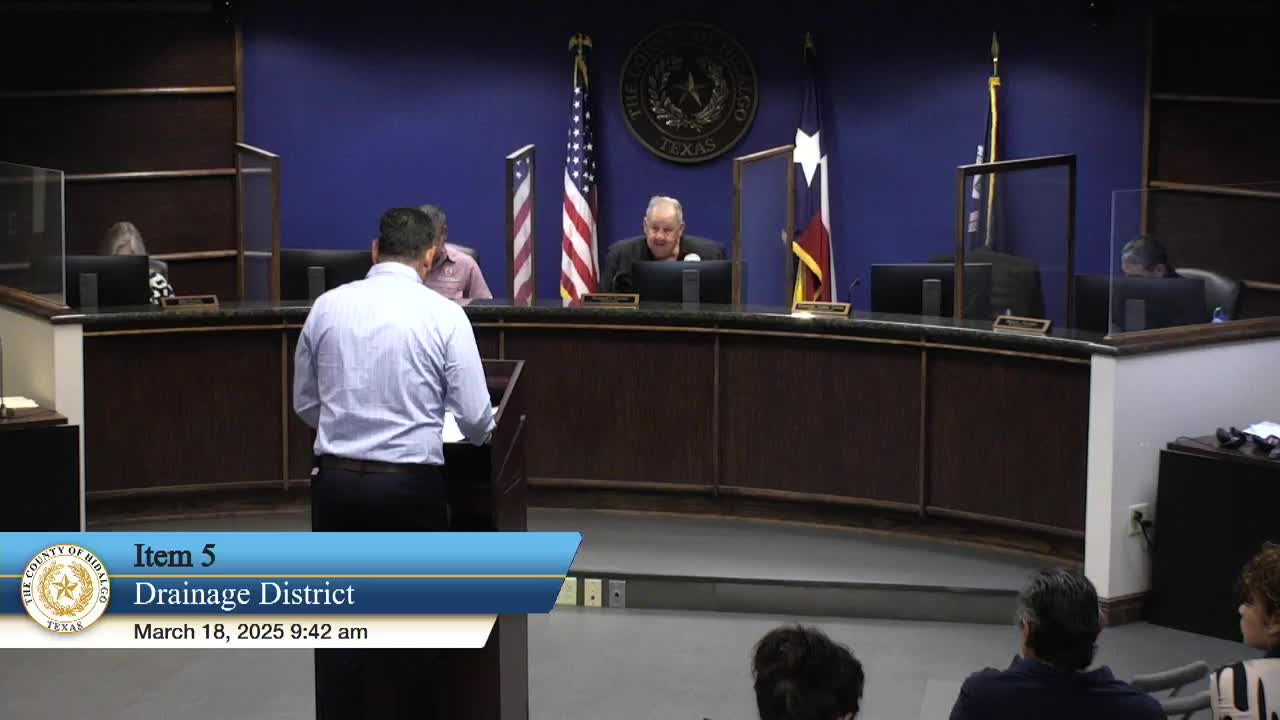
At the Hidalgo County Commissioners Court meeting March 18, staff from the county drainage district (ACD1) presented two alternative approaches to satisfy detention and drainage requirements for new subdivisions in rural areas and extraterritorial jurisdictions where a storm-drain outfall is not available.
ACD1 staff said the county faces recurring requests from developers to approve subdivisions where no nearby drainage system exists. The district’s staff proposed two main options: allow private detention ponds in unincorporated areas subject to district maintenance requirements and require a 15-foot maintenance road around each pond and a pilot channel to carry low flows; or permit roadside swales (gutters) to handle detention volume for subdivisions with lots larger than one acre, combined with wider road rights-of-way and a private-street/HOA maintenance structure.
“By allowing detention ponds … you would need to meet the ACD1 requirements for maintenance,” ACD1 development lead Yvette said, summarizing the first alternative and adding that the ponds should include an outfall for future connection and a 15-foot-wide maintenance road so equipment can access the site. She described the pilot channel concept as a way to carry low flows without creating a marshy bottom that is difficult to maintain.
On the second alternative, Yvette said roadside swales would be an option for subdivisions of 20 lots or fewer and where lots are larger than one acre; that approach would require slightly wider rights-of-way and establishment of a private-street subdivision recorded with plat and HOA maintenance covenants.
Staff emphasized caveats: the options would be limited to subdivisions more than a mile from a drainage and more than a mile from city limits; engineered drainage plans would still be required; areas with historic flooding or low-lying zones would not qualify. The district recommended that private maintenance obligations be recorded on the plat and that legal staff draft covenant language to address HOA failure scenarios.
Commissioners and other participants raised concerns about enforcement and long-term maintenance if an HOA dissolves, and the need to coordinate with the county planning department. Commissioner discussion focused on keeping maintenance private rather than transferring many small detention features to public maintenance systems. The court directed staff to work with legal and planning, refine the proposal and return with formal language and implementation details.
No formal ordinance or vote was taken on the alternatives; the action recorded in the transcript is a direction for staff to proceed with the work and return with more detailed recommendations.