Get Full Government Meeting Transcripts, Videos, & Alerts Forever!
Get email alerts on the Family Health Ccs Opioid topic
No spam. Unsubscribe anytime.
Counties press DHCS on underfunded California Children's Services; debate over opioid settlement spending
Summary
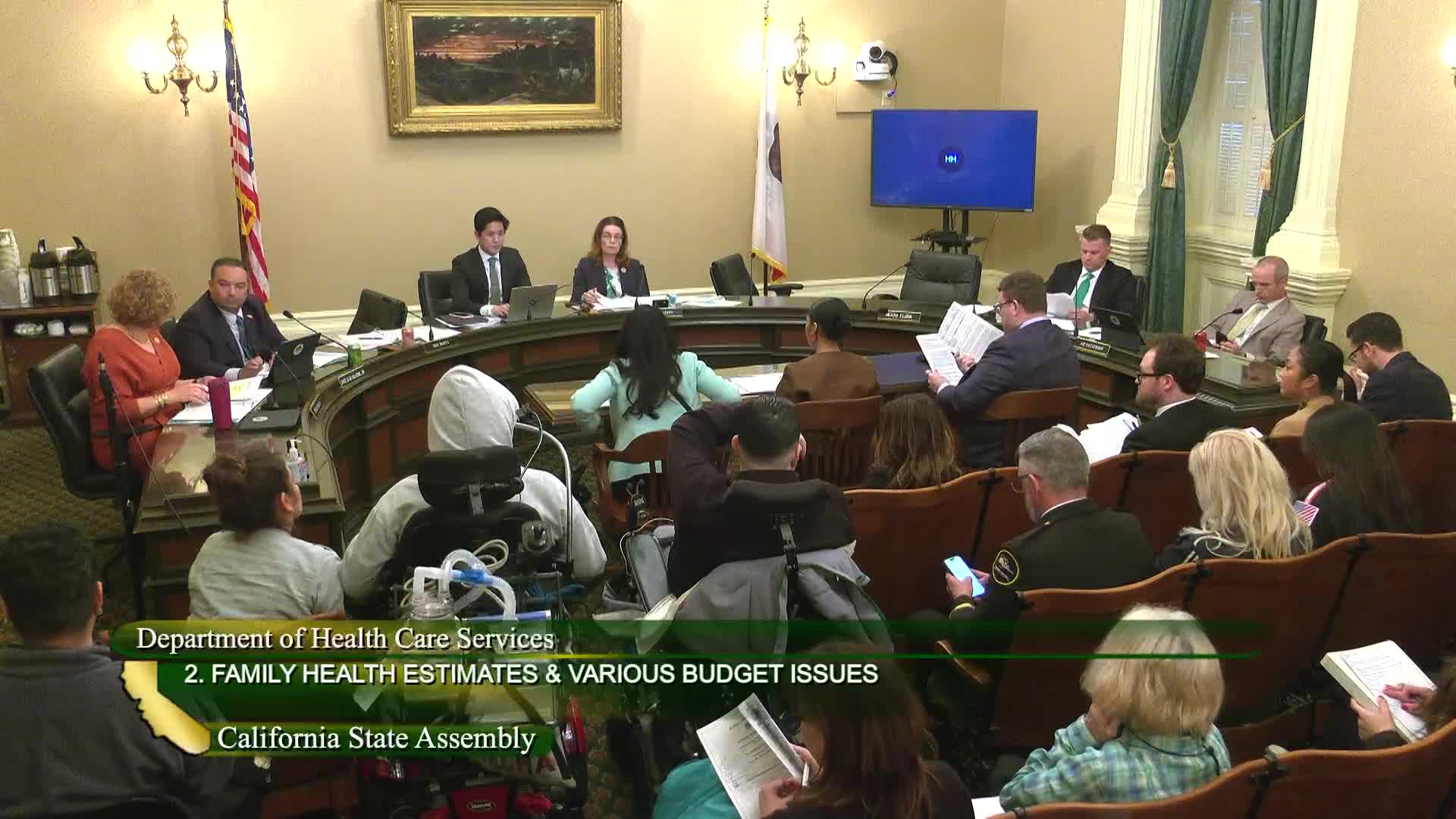
County and provider witnesses told the Assembly Subcommittee No. 1 on Health that recent CCS allocation changes have left some counties underfunded and asked the department to delay or adjust the monitoring and oversight rollout until funding and technical assistance gaps are addressed.
County and provider representatives told the Assembly Subcommittee on Health that recent changes to California Children’s Services (CCS) budget methodology left some counties underfunded and unprepared for new monitoring obligations.
Susan Philip, deputy director for Health Care Delivery Systems at the Department of Health Care Services, described a change to county CCS allocation methodology that bases allocations on counties’ recent average expenditures and average caseload rather than prior staffing‑standard calculations. Philip said DHCS has engaged with counties through monthly meetings with the County Health Executives Association of California (CHEAC) and has delayed full implementation of the CCS monitoring and oversight (MNO) program until July 1, 2025, after issuing an MOU and associated monitoring protocols.
CHEAC and county witnesses said the new approach left core CCS budgets short. Jack Anderson of CHEAC told the committee counties estimated a statewide underfunding of roughly $115,000,000 for 2024–25 using DHCS staffing standards and urged an indefinite delay of the MNO rollout until funding sufficiency is resolved. Philip said DHCS provided $10,000,000 in 2024–25 to support readiness activities and is developing a training program and provider manual to support county implementation; six counties have signed the MOU to date.
Opioid settlement and Naloxone question: The panel also discussed opioid settlement fund (OSF) revenues and the governor’s proposal to prioritize a Naloxone Distribution Project. Elizabeth Castillo of the Department of Finance said the governor’s budget included $8,300,000 in opioid settlement funds in 2025–26 for the Naloxone Distribution Project and maintained $41.7 million in OSF in 2024–25. The administration said it reexamined the OSF expenditure plan based on updated revenue estimates and prioritized naloxone procurement and distribution as an administration priority.
Several harm reduction providers and advocates urged that OSF allocations for syringe services and community harm‑reduction programs not be reduced. Speakers from harm‑reduction programs told the committee that community programs provide outreach and distribution that reduce overdose deaths and that many county OSF allocations remain unspent. Some advocates urged returning $8,400,000 of proposed Naloxone Distribution Project funding back to the California Overdose Prevention and Harm Reduction Initiative (COHRI/COFRE) to support community programs.
What was decided: DHCS pushed back the CCS MNO implementation date from an earlier schedule to July 1, 2025, and provided $10,000,000 for county readiness. The administration said it would reassess the opioid settlement expenditure plan at the May revision based on updated revenues.
Why it matters: CCS provides specialty diagnostic, treatment and therapy services for children up to 21 with serious medical conditions. Counties and advocates said adequate funding and technical assistance are needed to avoid service gaps and to ensure monitoring improves access rather than simply increasing administrative burden. The opioid settlement discussion raises questions about how front‑loaded settlement revenue, bankruptcy settlements and local spending affect statewide harm reduction programming.
Ending: Both county officials and community providers asked the Legislature and administration to work together to reconcile funding shortfalls, pace monitoring and oversight implementation and ensure that opioid settlement resources continue to support front‑line harm‑reduction services.