Get Full Government Meeting Transcripts, Videos, & Alerts Forever!
Get email alerts on the Ev Charging topic
No spam. Unsubscribe anytime.
Dane County begins planning phase for countywide EV charging network; advisory commission names officers
Summary
Dane County’s new EV Advisory Commission elected officers and heard details about a federally funded, two‑phase plan to site 60–70 publicly accessible charging locations. The planning phase is funded; construction funding is contingent on future federal awards.
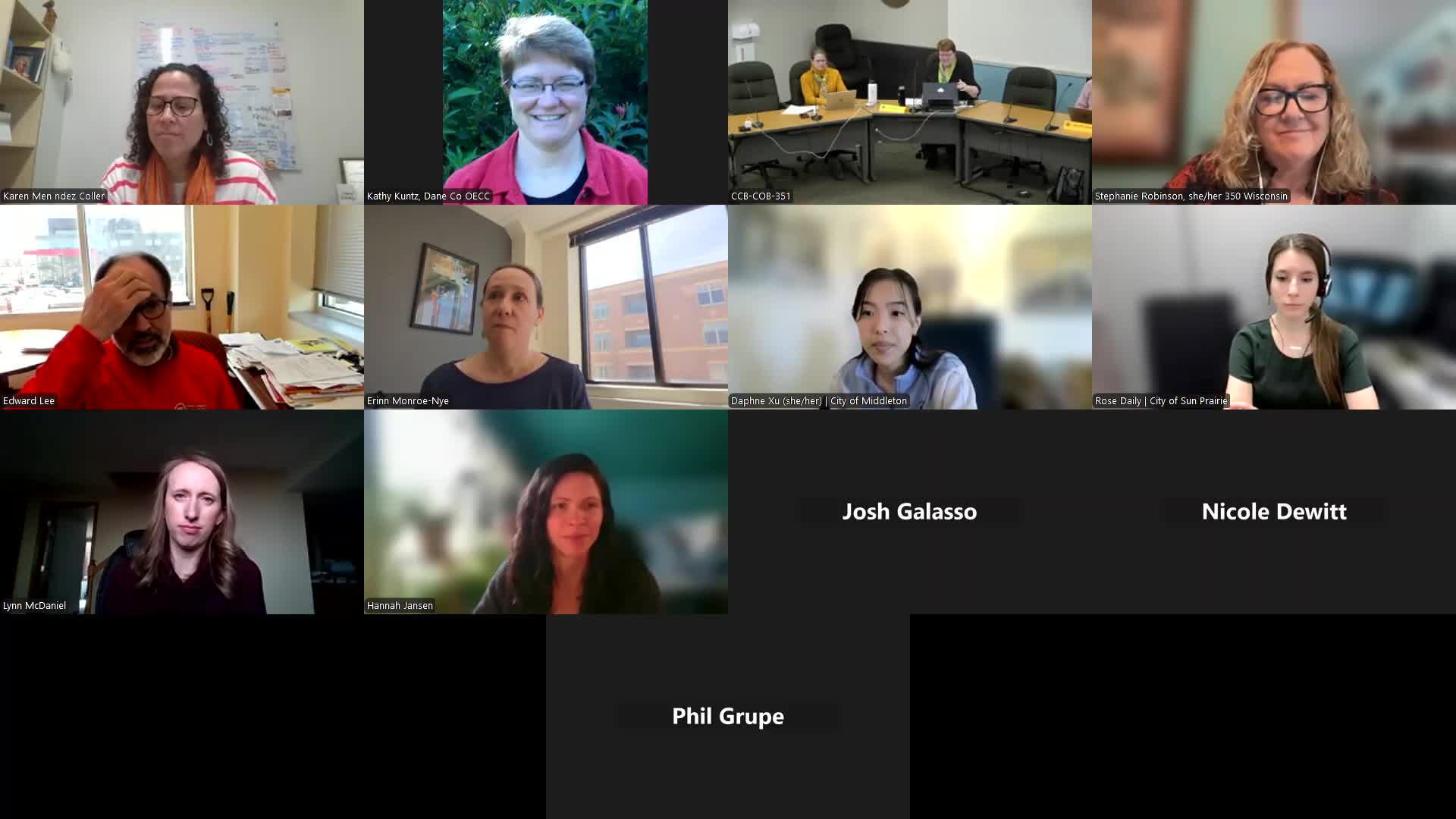
Dane County leaders and members of the newly formed Dane County EV Advisory Commission met March 17 to elect officers and begin planning a countywide electric vehicle (EV) charging network funded through a federal planning grant.
County Executive Melissa Agard, who attended the commission’s first meeting, said the body “is going to play a vital role in shaping the future of Dane County,” and noted that the county accounts “for roughly 25% of EVs across the state of Wisconsin.” The commission elected Kathy Kuntz, director of the Dane County Office of Energy and Climate Change, as chair and David Lonsdorf, a town board supervisor representing the Dane County Towns Association, as vice chair.
The meeting focused on the grant-funded planning phase that the county is launching with the Federal Highway Administration (FHWA) as the federal sponsor. County staff said the grant funds the planning and environmental review phase; the later construction phase is contingent on future federal construction awards. County staff are negotiating a contract with Veil Engineering to perform the preliminary design and environmental assessments and plan to issue a separate request for proposals (RFP) this spring to identify potential site hosts for charging stations.
Why this matters: County officials said the grant aims to expand publicly accessible, “affordable” charging — especially in multifamily housing areas, rural communities and multimodal hubs — where the private market is unlikely to install chargers on its own. The planning phase is intended to produce siting, preliminary design and environmental work that FHWA can bundle for possible future construction funding.
Key details from the meeting
- Funding and phases: Staff described a two‑phase project administered through FHWA. The county is funded for the planning phase; construction funds are not guaranteed. The county added a local match (discussed in the meeting as $1,600,000) to the award. County staff said they adjusted their ask and were funded at about 89% of original request and revised project targets accordingly.
- Project goals and scale: The county set a planning target of roughly 60–70 charging host locations, a range inserted after the award was reduced. Staff said that number would expand access but would not fully eliminate gaps across the county.
- Timeline and RFP for hosts: County staff said they expect to issue a simple RFP for site hosts as soon as April and keep it open for roughly a month. The RFP will ask basic, easily answered questions (for example, location and parking‑lot characteristics) so staff can map applicants against equity and siting priorities. Staff said they expect the engineering contractor to perform desktop screening and environmental review across prioritized sites during the two‑year planning window.
- Host eligibility and requirements: Sites must be publicly accessible and have free parking under current grant rules; that requirement complicates participation by entities that charge for parking (for example, many University of Wisconsin and City of Madison lots). Site hosts must be prepared to dedicate parking (staff described a typical commitment as approximately five years), and the grant requires that stations be operational at least 97% of the time during the first five years. Staff said they anticipate requiring vendors to provide a five‑year maintenance agreement to meet that uptime requirement.
- Ownership, maintenance and revenue: Staff said ownership models (county, host, vendor lease) are still to be determined. The county’s approach assumes station vendors will provide five‑year maintenance guarantees. Hosts would typically have agreements with vendors (examples named during the meeting included ChargePoint and large retail or network providers) that outline operations and revenue sharing; staff said revenue could offset operational electric costs for hosts.
- Selection process and commission role: County staff and consultants (not the advisory commission) will review and pick sites to avoid conflicts of interest; commission members are expected to act as ambassadors and help with outreach and identifying potential hosts.
- Community engagement: The county will launch an interactive online map and solicit public input, hold at least three in‑person open houses (one in Madison and others outside the city), and run webinars and tabling at community events. Staff said outreach must address community concerns — including fears that new infrastructure could accelerate gentrification — and emphasize benefits like lower operating costs and expanded access to EVs, especially for residents without home charging.
- Utility and technical considerations: Utility representatives (Madison Gas & Electric and Alliant Energy) urged early utility engagement in preliminary design. Utilities warned that transformer or service upgrades can add time and cost; they recommended screening potential sites for needed upgrades to avoid timeline delays. Staff agreed to coordinate with utilities as they prioritize applicants.
- Other site types and questions: Park‑and‑ride facilities, faith‑community parking lots and certain business parking lots were identified as potential hosts. Street parking, right‑of‑way installations and leased properties raise additional legal and logistical questions; staff said those cases will be handled on a case‑by‑case basis and noted owner sign‑off is typically required when lessees propose upgrades.
Quotes from the meeting
- “This Commission is going to play a vital role in shaping the future of Dane County,” Dane County Executive Melissa Agard said, urging the commission to focus on equitable access and public engagement.
- “This RFP has to be really simple… it’s maybe 7 or 8 questions that anyone who has a facility could answer about their parking lot,” Kathy Kuntz, director of the Dane County Office of Energy and Climate Change, said of the planned site‑host solicitation.
Votes and formal actions
- Motion to appoint Kathy Kuntz as chair: approved (motion made by a commission member; seconded by Christina Carbajal). Vote: unanimous in favor by attendees (commission reported 16 of 17 members present).
- Motion to appoint David Lonsdorf as vice chair: approved (moved by Sam Warden; seconded by Phil Gruppi). Vote: unanimous among present members.
What’s next
County staff said they will finalize negotiations with Veil Engineering and introduce a related contract resolution to the county board. The county will release the site‑host RFP in the coming weeks, begin the community outreach program (interactive map, webinars and open houses), and convene the advisory commission approximately every other month to review progress and inform outreach.
Ending
Commission members were asked to share suggestions for open‑house locations and community events where staff should present. Staff also said they will circulate an updated communications plan and post future meeting dates to Legistar. The commission’s next meeting schedule and outreach timeline will be circulated by email and posted to the county calendar.