Get Full Government Meeting Transcripts, Videos, & Alerts Forever!
Get email alerts on the School Safety topic
No spam. Unsubscribe anytime.
Panel approves school-safety package bill; debate centers on charging juveniles as adults for terroristic acts
Summary
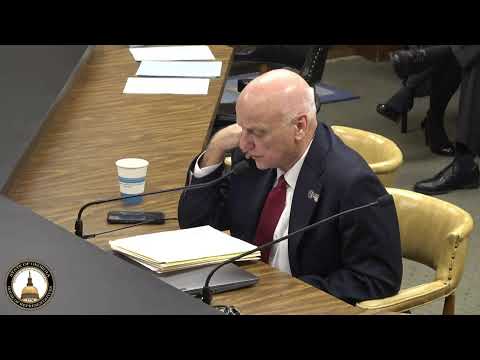
Senate Bill 61, presented to the Judiciary Committee as part of a three-bill school-safety package, passed after hours of testimony that centered on a provision allowing certain school-related "terroristic acts" by minors to be prosecuted in superior court.
Senator Dolezal told the Judiciary Committee that Senate Bill 61 is part of a three-bill school-safety package and described four principal components: creating new school-related terroristic-offense statutes, expanding superior-court jurisdiction for certain serious underlying offenses, requiring notification to public schools when an enrolled or prospective student is placed under electronic monitoring or intensive supervision, and mandating annual site threat assessments in partnership with local law enforcement and GEMA.
"Senate Bill 61 really does 3 main things," Senator Dolezal summarized. He said the bill draws a line between terroristic threats and terroristic acts, and — after committee changes — would permit minors to be charged as adults in superior court for terroristic acts only, not for threats. The draft also adds attempt and conspiracy to the universe of offenses that may be prosecuted in superior court when predicated on the designated underlying felonies.
The bill drew extensive testimony from advocacy groups, school-policy organizations and defense lawyers who urged the committee to narrow or remove the juvenile-to-adult provisions. Mikayla Arciaga of the Intercultural Development Research Association said SB 61 "takes an overly punitive approach" and warned it would "exacerbate discipline and school-to-prison disparities," particularly for students with disabilities or limited English proficiency. Morgan Bridgeman of Georgia Appleseed said the state already has juvenile and education-code options to address school disturbance and that processing large numbers of school-related threats in superior court would "flood both our juvenile and our superior court systems." She said many recorded incidents are non-credible threats or typical adolescent behavior.
Russell Gabriel, introduced by the Georgia Association of Criminal Defense Lawyers, and other defense witnesses focused on statutory mechanics, arguing that including attempt and conspiracy could criminalize a wide range of preparatory conduct by juveniles. "The definition of attempt only requires that the government prove ... a substantial step," Gabriel said, warning that seemingly minor acts — buying a burner phone or talking about a plan — could be charged as designated felonies if attempt or conspiracy provisions apply.
District Attorney Cranford testified in support, saying prosecutors and local law enforcement need tools and time to investigate serious school-related acts and that the current juvenile-code mechanism does not always allow sufficient time for full criminal investigations. "The current juvenile code doesn't sufficiently protect victims and the innocent public from ... very dangerous juveniles," Cranford said.
Committee members debated competing policy priorities: keeping schools safe and ensuring interventions appropriate to youth development. Representative Panish moved to strike sections 1 and 4 (the juvenile-to-adult and new-offense provisions); that amendment failed on a committee voice vote. The committee then voted to pass SB 61 as drafted in committee. The transcript records robust public testimony and multiple requests for line-by-line changes; proponents and opponents agreed on the need for more school-based mental-health services, but differed sharply on whether this bill was the right approach.
Ending: Senate Bill 61 passed the Judiciary Committee after extensive public testimony and debate. Supporters called it a measured step to give prosecutors and schools tools to respond to credible threats and acts; opponents urged reliance on juvenile procedures, behavioral-health investments and limiting new adult prosecution pathways for children.