Get Full Government Meeting Transcripts, Videos, & Alerts Forever!
Get email alerts on the Hospital Acquisition topic
No spam. Unsubscribe anytime.
UCSF reports investments and operational steps six months after acquiring St. Mary’s and St. Francis
Summary
UCSF Health told the San Francisco Health Commission it is investing in facilities, IT and staffing at the two community hospitals it acquired from Dignity Health, and said it remains committed to Medi‑Cal and behavioral health services while noting higher-than-expected deferred maintenance and early operating losses.
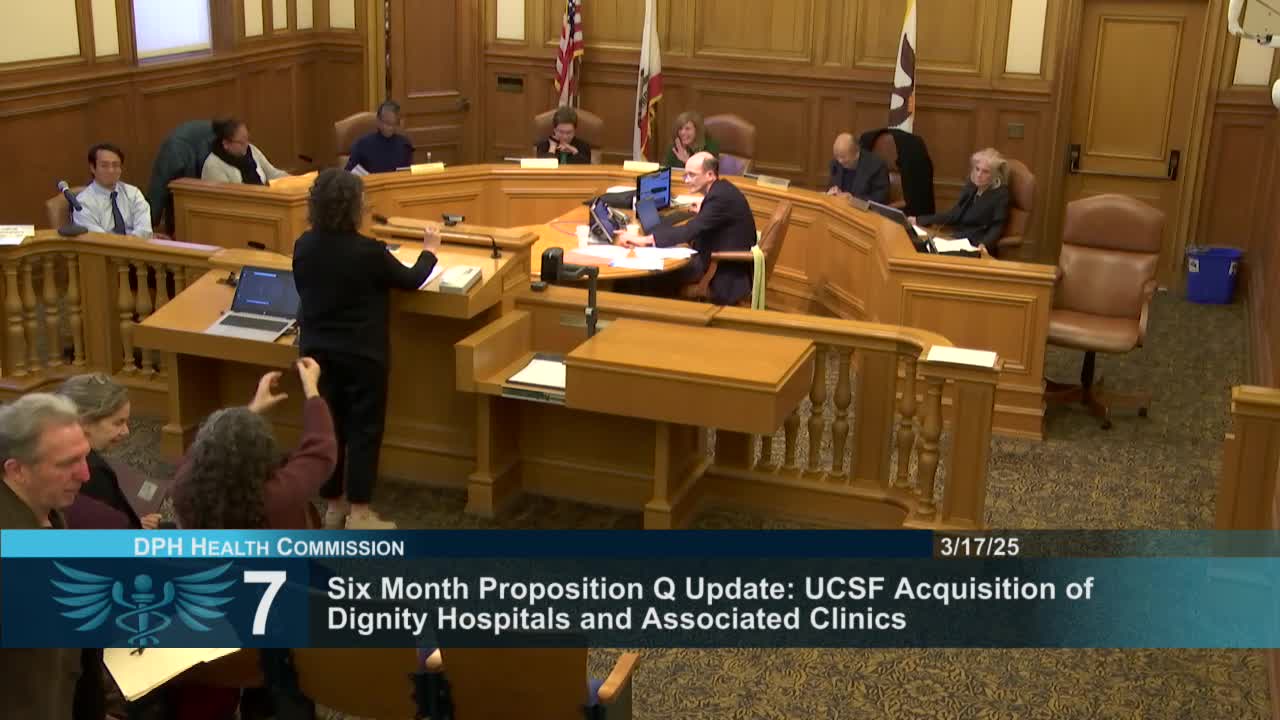
UCSF Health on Monday provided the Health Commission its first six-month update after acquiring St. Mary’s and St. Francis hospitals and associated clinics from Dignity Health, reporting immediate capital investments, an electronic medical record migration and commitments to maintain access for Medi-Cal beneficiaries and behavioral health patients.
In a public briefing, UCSF and Department of Public Health staff said the acquisition closed on Aug. 1, 2024, following a cooperative settlement with the California Attorney General. UCSF’s update described significant deferred maintenance discovered after the closing and an operating loss of more than $50 million across the two community hospitals since the acquisition. UCSF said it has already invested more than $20 million in core facilities and equipment and more than $40 million in IT infrastructure, including a planned transition to UCSF’s Epic electronic medical record system in October 2025.
“Improving the infrastructure and investing in support needed to expand and enhance patient care that is already there,” Executive Vice President and Chief Clinical Officer Josh Adler told commissioners, adding UCSF would apply system clinical practices and expand subspecialty consult availability to support hospital-medicine services.
UCSF said it is working to increase inpatient census and throughput: the health system plans to expand hospital medicine services and open additional units that it said could create capacity for as many as 75 additional patients per day at St. Mary’s. The update also said UCSF has strengthened pediatric specialty care at St. Francis and is pursuing state Prop 1 funding in partnership with DPH to expand behavioral-health services on the St. Francis campus.
On governance and workforce, UCSF said the two hospitals are now owned by a nonprofit subsidiary, UCSF Health Community Hospitals, which maintains separate hospital licenses and a separate fiduciary board. Employees of St. Francis and St. Mary’s became UCSF employees and remain covered under existing collective bargaining agreements; UCSF said it honored the acquisition pledge that no layoffs would result from the transaction and that medical staffs at the two hospitals remain open models.
Commissioners asked how operating losses would be reduced and whether federal or state funding changes could affect planned services. UCSF said facility repairs, the Epic integration and clinical growth would be part of the plan to reduce losses; it noted that loss of federal research funding would not directly affect clinical services, but warned that a broader reduction in Medicare or Medicaid funding would have nationwide implications.
UCSF provided some lease details for associated outpatient facilities: the Cresthaven (Crestwood) lease expires in April 2028; the Kentfield lease expires in February 2026. UCSF said it is not planning to consolidate major services at this stage and that service-consolidation decisions would be considered only if volume and quality analyses suggested it was appropriate.
Department of Public Health Director Mark Tsai thanked UCSF for collaboration on behavioral-health planning and said DPH expected the St. Mary’s and St. Francis footprint to help address city needs for locked and subacute behavioral-health beds if state Prop 1 funding is secured.
No formal action was taken by the commission; UCSF and DPH agreed to return with additional utilization and workforce data after a full year post-acquisition to permit pre/post comparisons once records and systems are fully integrated.