City and Mercy Housing advance senior affordable housing plan at Laguna Honda campus
Loading...
Summary
Officials and developers presented a two-phase plan for senior affordable housing and on-site child care at the Laguna Honda Hospital campus, outlining proposed unit counts, financing history and a preliminary schedule while commissioners and community members raised questions about eligibility, financing and timing.
San Francisco officials and Mercy Housing California on Monday presented a two-phase proposal to build 100 percent affordable senior housing and on-site child care at the Laguna Honda Hospital campus, describing a path intended to add independent-living units in a first phase and enhanced-services units with an adult day health center in a later phase.
The Mayor’s Office of Housing and Community Development and Mercy Housing said Phase 1 would include independent-living senior rental housing targeted to households at a maximum of 55% of area median income (the presenters said that is roughly $65,000 annually for a two-person household) and an Early Childhood Education Center. Phase 2 is described as supportive “enhanced services” housing with an adult day health center; Mercy and MOHCD said additional coordination with the Department of Public Health will be required to finalize service elements and financing for Phase 2.
Project backers said the idea traces to prior bond commitments and city planning dating back decades, and that a $50 million set-aside for senior housing was included in Proposition A, the 2019 general-obligation affordable housing bond. Mercy Housing received a $3 million predevelopment loan in 2020 and restarted planning after Laguna Honda regained Medicare/Medicaid certification in 2024. Mercy and the mayor’s office described a preliminary schedule that would advance site entitlements through 2025, seek financing and ground-lease options in 2026, and — if financing applications succeed — begin Phase 1 construction as early as 2027 with completion in 2029; Phase 2 would follow and is expected to start after Phase 1.
Speakers and supporters framed the project as a way to expand the city’s continuum of care near Laguna Honda, add childcare that could help recruit and retain hospital staff, and provide housing options for seniors stepping down from higher levels of care. “Adding child care at Laguna Honda Hospital was part of the original vision,” said former City Attorney Louise Renne, who also recounted the history of earlier bond efforts and environmental reviews that envisioned assisted-living and intergenerational programming.
Presenters described a massing concept showing Phase 1 with roughly 124 one-bedroom independent-living units and Phase 2 with about 90 studio units for enhanced services; Mercy’s presentation repeatedly stressed these figures are preliminary. Mercy and MOHCD recommended planning Phase 2 as an enhanced-services affordable rental model rather than a licensed Residential Care Facility for the Elderly (RCFE), citing uncertainty about a financing path for an affordable, licensed assisted-living model.
Commissioners and members of the public pressed for more detail on several points: which income tiers would receive units set to be subsidized so residents could pay 30% of income; how many units would be permanently reserved for Laguna Honda referrals or discharged patients; what the admission and eligibility rules would be for both the housing and the proposed child-care center; and whether Phase 2’s enhanced-services model would be delayed or jeopardized if federal financing programs change. Commissioner Chao asked for clarity on access and on how the child-care entrance and circulation would work given the campus topography.
Several community providers and union representatives spoke in favor of the project. Stepping Stone Health and Catholic Charities described operational experience running adult day health in Mercy Housing communities and urged the commission to support the continuum-of-care approach. SEIU Local 1021 urged prioritizing Laguna Honda workers for childcare slots and pushed the commission not to let the project stall, warning that staffing shortages worsen when workers lack affordable childcare and housing.
Speakers also raised concerns. Remote commenters and at least one in-person speaker asked that the bulk of units be affordable to the lowest-income seniors (including those living on Social Security or disability), and one public commenter alleged prior “bait-and-switch” changes in unit counts and program type across planning iterations. Mercy representatives and MOHCD officials said they would restart neighborhood outreach, had formed a Neighborhood Advisory Committee, and planned an enhanced-services working group beginning in April 2025 to define service elements for Medi-Cal-eligible residents.
The presenters described key legal and administrative steps ahead, including a non-binding term sheet (in the meeting packet appendix), a predevelopment memorandum of understanding to define roles, and an option to ground lease in 2026 to demonstrate site control for financing applications. Presenters said MOHCD would oversee predevelopment loans, construction compliance and operational restrictions tied to affordability covenants through a long-term ground lease.
If financing paths change — for example if HUD Section 202 senior housing financing were no longer available — presenters said Phase 2 could still be feasible using competitive affordable-housing financing, though with potential delays.
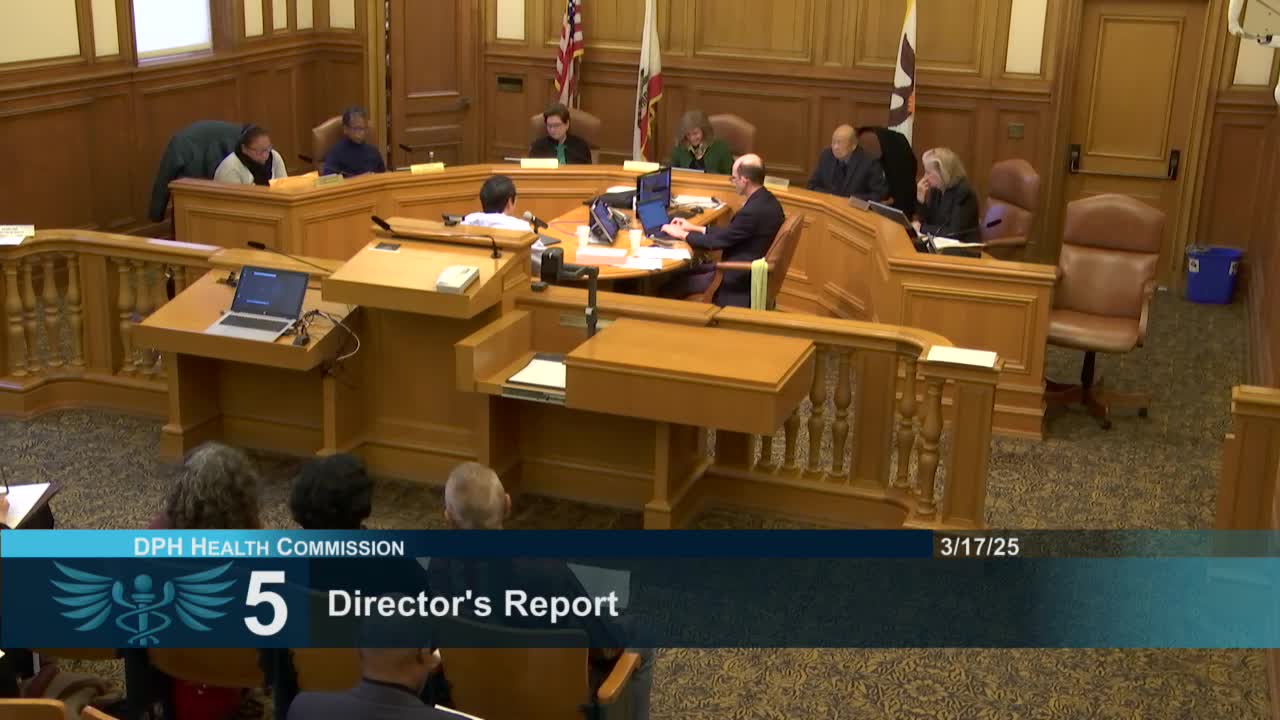
The commission did not take formal action on the housing plan at Monday’s meeting; commissioners asked for a follow-up briefing with clearer eligibility criteria, clarified service definitions for Phase 2, and more detail on how childcare will be prioritized for Laguna Honda staff and for the surrounding neighborhood.
Looking ahead, Mercy, MOHCD and DPH said they will continue coordinated planning and outreach, refine the term sheet and ground-lease structure, and return to the commission with more complete financing and eligibility details as they become available.