Get Full Government Meeting Transcripts, Videos, & Alerts Forever!
Get email alerts on the Rail Corridor Reuse topic
No spam. Unsubscribe anytime.
Committee asks city departments to explore acquisition and reuse of 30th Street rail corridor; engineering study funded
Summary
Aldermen directed DCD and the city attorney to begin discussions with the short-line railroad over the 30th Street rail corridor to explore shared-use possibilities for freight, trails and future rail transit. State DOT funding will support an engineering study beginning in May to produce 30% designs for alternatives.
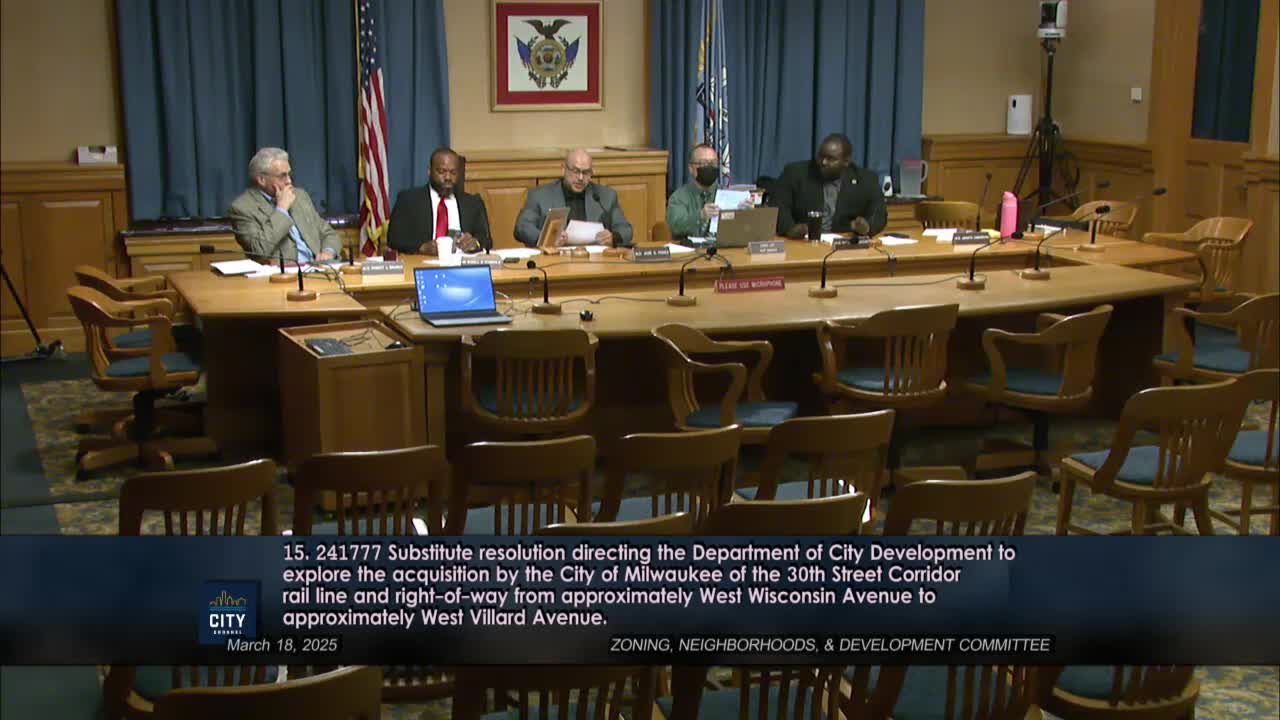
The committee approved a directive for the Department of City Development and the city attorney's office to begin discussions about the potential acquisition, shared use, or other repurposing of the 30th Street industrial rail corridor from roughly West Wisconsin Avenue to West Villard Avenue.
Alderman Robert Bauman, sponsor of the file, said the corridor offers a rare, grade-separated transportation right-of-way through the north side of Milwaukee that could support freight operations while also accommodating shared-use trails, bicycle and pedestrian connections, and potential future rail transit.
City Attorney Evan Goyke told the committee the rail line is a long-lived asset that historically served heavy industry. He said railroad owners commonly plan on long time horizons and that a city-railroad partnership would be necessary to unlock the corridor's wider benefits. Goyke described recent on-site observations and growing neighborhood concerns about illegal dumping and vacant properties adjacent to the right-of-way.
Officials also reported a separate step already underway: the Wisconsin Department of Transportation has allocated just over $700,000 to Milwaukee County for consultant work that will begin May 1 to produce an engineering study and alternatives analysis. The DOT-funded work will seek 30% design-level schematics for corridor alternatives, including where shared-use trails could use the rail right-of-way and where on-street alignment would be required.
Aldermen and staff said the immediate goal is dialogue rather than acquisition; a letter from the short-line operator in the record stated the company was not prepared to sell the corridor. The committee vote instructs city departments to open negotiations, study options, and coordinate potential state and county partners. The motion passed without objections.