Get Full Government Meeting Transcripts, Videos, & Alerts Forever!
Get email alerts on the Firearms Policy And Budget topic
No spam. Unsubscribe anytime.
DOJ seeks firearm workload funding; LAO urges framework to align fees, general fund support and large IT costs
Summary
The Department of Justice requested tens of millions for firearm workload and IT modernization; the LAO told the committee that many firearm workloads have shifted from special fund to general fund support and recommended a legislatively‑directed framework by January 2026 to decide which work should be fee supported.
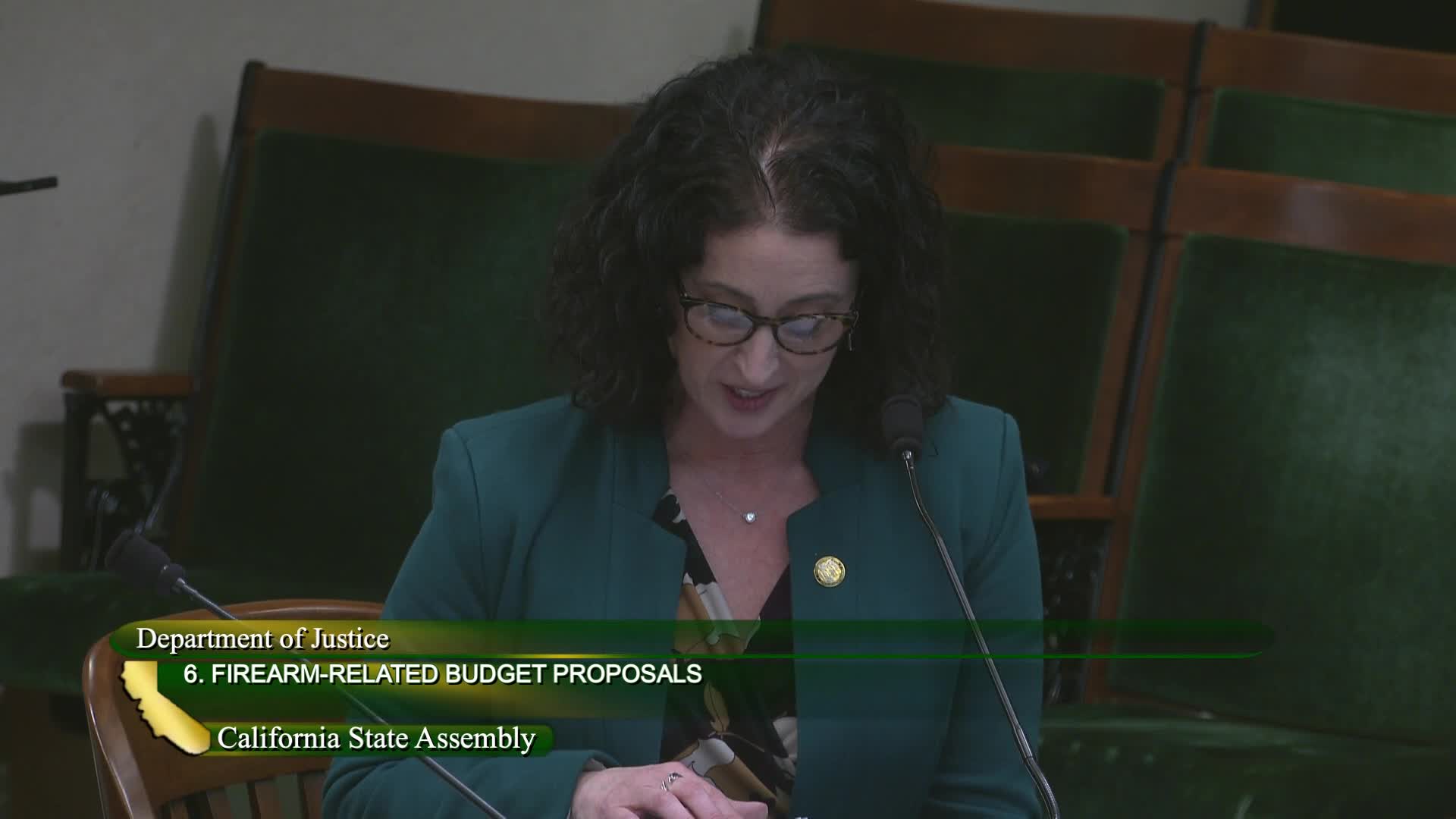
The Bureau of Firearms at the Department of Justice told the Assembly subcommittee the governor’s budget proposes $19.2 million in 2025‑26 (about $18.6M General Fund and other funds) declining to $6.4M ongoing to support workload tied to new legislation, background checks, and the state’s Carry Concealed Weapon program.
Allison Mendoza, Bureau Chief, said the request covers expanded background check and eligibility clearance workload, continued IT modernization to replace legacy firearms and ammunition databases, and staff to handle increased Carry Concealed Weapon (CCW) applications following recent U.S. Supreme Court and district court rulings. Mendoza said CCW applications rose about 34% for initial applications and 15% for renewals since mid‑2022 and that a recent decision will require limited acceptance of some non‑California resident CCW applications in April, which could increase workload further.
The LAO raised two broader concerns. First, many firearm‑related workloads previously funded by regulatory (special) funds have increasingly been shifted to General Fund support as certain special funds face insolvency — a trend the LAO said produced inconsistent funding decisions. Second, LAO recommended the Legislature ask DOJ to provide a framework (by January 2026) identifying which workloads should be paid from fees, proposing appropriate fee levels and calculations, and recommending statutory clarifications where needed.
The LAO also noted a large DOJ IT modernization project (replacing 17 firearm and ammunition systems) that will likely cost several hundred million dollars and said that decision heightens the need to align fee structures and funding responsibilities over the next several years.
DOF said it supports the administration’s requested flexibility and noted ongoing discussions with LAO and DOJ about fund source choices.
Why it matters: The allocation of firearm workload costs between special fund fee revenue and the General Fund has fiscal and programmatic consequences. LAO’s recommended framework would help the Legislature decide what work is fee‑supported, what requires General Fund subsidy, and how to set fee levels consistent with evolving court decisions and large IT modernization needs.
Ending: The subcommittee asked DOJ and the Department of Finance to continue discussions with LAO and return with the comparative fund‑source framework and a plan to address the long‑term funding needs of the firearms IT modernization effort.