Get Full Government Meeting Transcripts, Videos, & Alerts Forever!
Get email alerts on the Pensions topic
No spam. Unsubscribe anytime.
House retirement panel hears backing for bill to restore pension purchasing power
Summary
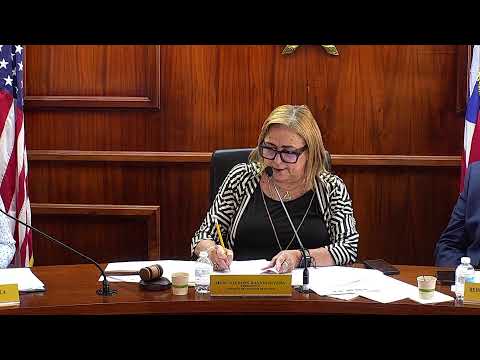
Representative Lourdes Ramos Rivera, sponsor of House Bill 45, presided over a March 18, 2025, public hearing of the House Commission on Retirement Systems that featured testimony urging prompt approval of the measure to protect the purchasing power of pensions for public employees, retirees from government corporations and municipalities, and future beneficiaries.
Representative Lourdes Ramos Rivera, sponsor of House Bill 45, presided over a March 18, 2025, public hearing of the House Commission on Retirement Systems that featured testimony urging prompt approval of the measure to protect the purchasing power of pensions for public employees, retirees from government corporations and municipalities, and future beneficiaries.
The bill’s proponents said the measure would provide an initial one-time increase—structured as an increase between 10% and 7% in the first year with a cap tied to a maximum monthly amount—and establish an ongoing adjustment indexed to the federal Social Security cost‑of‑living adjustment (COLA) or a comparable index, with funding identified largely from net receipts of Puerto Rico’s sales‑and‑use tax (IVU).
Pedro Pastrana, a retired professor and spokesman for the chapter of retirees affiliated with the Federación de Maestros de Puerto Rico and the Frente en Defensa de las Pensiones, presented a detailed written ponencia and framed the bill as a response to long-running loss of purchasing power. Pastrana said the retirement population is large and vulnerable: “Invertir en los jubilados es invertir en el desarrollo social económico de Puerto Rico.” He cited studies he said were in the bill’s exposition of motives, including a 2019 study commissioned by the Financial Oversight and Management Board that he said projected a 39% decline in purchasing power from 2007 to 2037 and noted that earlier adjustments through 2023 already reflect a roughly 39.5% cumulative loss.
Pastrana and other witnesses told the commission the bill’s first‑year cost is in the vicinity of $200 million according to the Frente en Defensa de las Pensiones and $194.8 million according to the Office of Legislative Budget (OPAL). The proponents identified a subset of IVU receipts not earmarked to municipalities, the municipal administration fund, or COFINA debt service as the primary financing source and read aloud IVU net‑revenue figures for fiscal years 2020–2024 that were included in the written submission.
Commission members and co‑sponsor Representative Denis Márquez LeBrón discussed technical options for delivering relief while addressing legal and fiscal constraints raised in prior review. Márquez suggested alternatives to an explicit cost‑of‑living formula—including a tiered bonus table that delivers larger increases to lower pensions—while stressing the need to produce options that withstand constitutional equal‑protection review and that can be negotiated with the Financial Oversight and Management Board. "Si nos olvidamos del concepto de costo de la vida y hablamos de bonificaciones... podría ser eso una alternativa," Márquez said while asking witnesses about feasibility.
Members of the commission pressed for additional data from the Retirement System to refine financing assumptions. Representative Reinaldo Figueroa asked the system for a year‑by‑year list of retirees who died versus new entrants to the pension rolls so the panel can evaluate how demographic turnover might affect the program’s cost. The commission recorded a staff direction to request that information from the Retirement System.
Several legislators emphasized the bill’s social‑justice framing and the urgency of acting after long periods without adjustments. Representative Vimary Peña Dávila noted there are roughly 160,000 retired public employees in Puerto Rico and repeated proponents’ concern that many retirees have low monthly pensions; panelists said a large share receive $2,000 monthly or less and that a substantial portion depend on nutrition assistance. Panelists and legislators also discussed the risk that, absent action, the share of retirees below the federal poverty line could rise.
Witnesses and legislators said the proposal would apply to the three retirement systems merged under Law 106 (government‑central, teachers/magisterio and judiciary) and that the bill’s authors had tried to craft the measure to treat retirees equitably across those systems. Pastrana said the proposal aligns with the federal COLA timing—announced in December and effective the following January—so the Legislature could factor the adjustment into the next fiscal year budget process.
No formal vote or recorded committee action on the bill took place at the hearing; the session was a public‑information and fact‑finding hearing. The committee chair indicated additional written ponencias and witnesses will be scheduled for future hearings and that staff will transmit the commission’s data requests. Representative Lourdes Ramos Rivera said she would continue efforts to negotiate with the Financial Oversight and Management Board and to pursue alternatives to facilitate enactment.
The commission closed the hearing after agreeing to schedule further testimony from organizations that had submitted written statements and to pursue the requested demographic and fiscal data needed to refine cost and financing estimates.