Get Full Government Meeting Transcripts, Videos, & Alerts Forever!
Get email alerts on the Fond Du Lac School topic
No spam. Unsubscribe anytime.
Fond du Lac Ojibwe School urges sustained funding for immersion, attendance supports and mental‑health services
Summary
Tara Dupuy, superintendent of the Fond du Lac Ojibwe School, told the committee the Cloquet‑area tribal school serves about 40 students, requires Ojibwe language coursework for graduation, and depends on partnerships and grant funding to sustain programs amid staffing and student‑well‑being challenges.
Tara Dupuy, superintendent of the Fond du Lac Ojibwe School, told the Minnesota State Education Finance Committee on March 18 that the small tribally controlled school in Cloquet provides daily Ojibwe language instruction and culturally rooted seasonal programming but faces budgetary pressures that threaten key staff and programs.
Dupuy told the panel the school serves about 40 students this year, with about 98 percent of students qualifying for free or reduced‑price lunch and about 30 percent qualifying for special education services. She said the school offers daily Ojibwe language for K‑12 (about 50 minutes a day), requires at least two years of Ojibwe language for graduation, and operates a WASH immersion program for 3‑ to 5‑year‑olds.
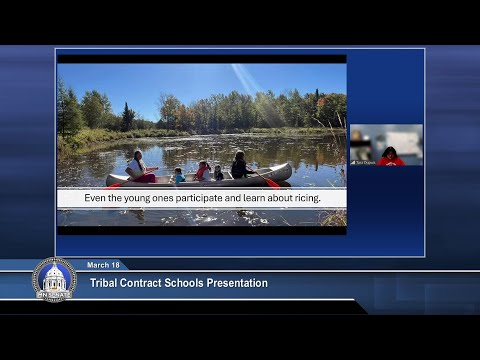
The superintendent described deep community programming — seasonal rice harvests, powwow and festival celebrations, maple‑sugaring activities and a community garden — and formal agreements with the Cloquet School District that allow Fond du Lac students to participate in sports and permit high‑school students to take career and technical education (CTE) classes such as carpentry, welding and commercial driver's license training.
Dupuy said the school relies on grants and tribal partnerships to sustain cultural and enrichment programming and that competing with larger districts for licensed teachers — particularly special education and secondary math and science instructors — is a continuing staffing challenge. "We do our best to hire staff who reflect our student body to foster a sense of belonging," Dupuy said, but added that newly trained Native teachers are often hired away because larger districts can offer higher pay.
She described several attendance initiatives the school has used, including year‑end recognition and $100 gift cards for students with perfect attendance, daily classroom attendance shout‑outs on the school's Facebook page, and a check‑and‑connect mentoring program that works directly with families. When Sen. Swadzinski asked for examples, Dupuy said the gift‑card ceremony and Facebook recognition have been effective, and noted that check‑and‑connect mentors make weekly home contacts to help families address barriers to attendance.
Two students also addressed the committee. Bella Feneris, a junior and the student council president, said returning to the tribal school improved her engagement: "I was a failing student who never wanted to come to school ... I'm now the student council president, and I feel more comfortable doing extracurriculars," she said. Kenny Bosco, an eighth‑grader, told the committee he values cultural classes such as beading and sewing and said, "I like it here because it's less complicated and I get help when I need it here."
On family stability, Dupuy said many students live with grandparents or extended family and that parental incarceration and addiction are real factors for a notable share of families; when asked she estimated roughly 30 percent of families experience parental incarceration at some point during the school year. She said those circumstances make service coordination — notarizations, guardianship paperwork and social services — a routine part of school administration.
Dupuy closed by asking for continued support for the school’s cultural, mental‑health and staffing needs, and committee members thanked her and the students for testifying.