Get Full Government Meeting Transcripts, Videos, & Alerts Forever!
Get email alerts on the Tribal Schools topic
No spam. Unsubscribe anytime.
Leech Lake tribal school tells committee PFAS, long bus routes and funding gaps hinder student support
Summary
Dan McKeon, director of the Bug‑O‑Nay‑Ge‑Shig School, told the Minnesota State Education Finance Committee on March 18 that the tribally controlled K‑12 school serves about 200 students but is coping with PFAS‑contaminated drinking water, long bus rides, trauma‑driven needs and fragmented funding streams.
Dan McKeon, director of the Bug‑O‑Nay‑Ge‑Shig School, told the Minnesota State Education Finance Committee on March 18, 2025, that his tribal K‑12 school — located near Bena on the Leech Lake Reservation — faces a combination of infrastructure, staffing and student‑support challenges that outstrip available funding.
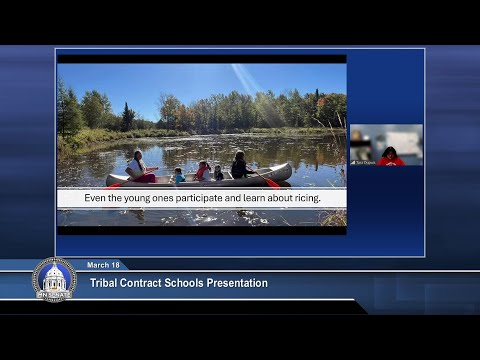
McKeon said the school enrolls approximately 200 students and offers strong Ojibwe language and cultural programming, including a K‑6 immersion program he identified as Negani and daily language instruction of 60 to 90 minutes. He described the school as tribally controlled and funded through a mix of federal and tribal sources, with 25 separate funding streams and a substantial share of dollars coming from the Bureau of Indian Education through the Indian Student Equalization Program (ISEP).
The school director emphasized how geography and transportation shape the operation: buses travel long distances across the reservation — in some cases students ride up to 90 minutes one way — and the district covers the area between Grand Rapids and Bemidji along Highway 2. "We have students who ride for 90 minutes one way to attend school here," McKeon said.
McKeon told the committee that trauma‑informed supports are central to the school’s day. He described a sizable student‑support team that greets students each morning and offers school‑based social work, counseling, home‑school liaison services and behavioral interventions. He said those services, along with a mentorship program that pairs staff with students and requires compensated weekly home contacts, are important but hard to sustain with existing funding.
He also described a PFAS contamination problem that forced the school to shut down its water system. "As soon as we got the test results, we shut our water system down and we've been operating with water that gets trucked in every week," McKeon said, adding that the school has relied on bottled or trucked‑in water since the winter of 2023 while it works with the Leech Lake environmental team and the BIE on a new well and distribution infrastructure.
On funding and governance, McKeon said tribal contract schools receive federal ISEP per‑pupil dollars and noted one feature that complicates finance: students who are enrolled members of the Leech Lake Band of Ojibwe generate different federal funding levels than students who are not enrolled, because of enrollment criteria administered by the BIE. He also described a recurring administrative tension: the BIE sets some standards (for example, a lower required number of instructional hours) while Minnesota state policy sets other, higher requirements, and tribal schools sometimes must choose which standard to follow.
McKeon outlined recent academic work, including a post‑pandemic push to accelerate reading recovery and reduce learning gaps, and said the school has reduced teacher turnover by reworking salary schedules and offering the small‑school advantages that some staff value. He invited committee members to visit the school and noted ceremonies and elders’ roles in daily school life.
Committee members thanked McKeon and asked follow‑up questions about the PFAS testing and remediation timeline. McKeon said a contractor has been approved to drill and connect to a clean source and that the project is under way but that securing and administering federal BIE facility dollars has been time‑consuming.
The presentation highlighted the intersection of infrastructure, public health, transportation and culturally specific programming at a rural tribal school — issues committee members said they would continue to consider as they work on education funding.