Get Full Government Meeting Transcripts, Videos, & Alerts Forever!
Get email alerts on the Agriculture Environment topic
No spam. Unsubscribe anytime.
Senate committee lays over bill to give partial property tax credit for buffer strips, adopts A1 amendment
Summary
Senate File 960 (as amended) would create a 40% property tax credit for agricultural land enrolled in state-required riparian buffers and reduce riparian protection aid to offset the cost; the committee adopted an A1 amendment and laid the bill over.
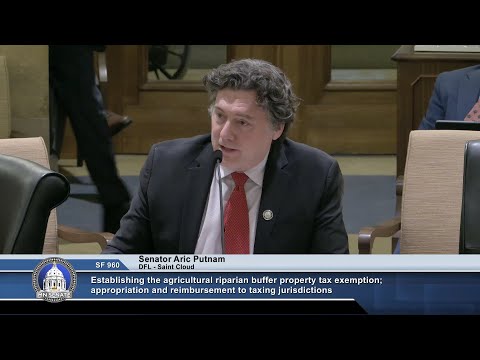
Senate File 960, presented March 18 in the Senate Taxes Committee, would provide a partial property tax credit to agricultural landowners for acreage subject to state-required riparian buffers. Sponsor Senator Mark Putnam said the bill aims to address what he called a lingering inequity: farms that comply with buffer requirements remain taxed as if the land were still in full agricultural production.
"This bill provides a partial property tax credit for agricultural land that the government has taken out of production and shifts some of the resources dedicated to implementation and enforcement of the program to pay for that property tax relief," Senator Putnam told the committee.
The bill, as described in committee and in the A1 amendment, would define eligible lands, set the credit at 40% of net tax capacity, establish accountability measures, describe payment processes, and specify appropriations. Putnam and witnesses cited Minnesota Statute 103F.48, which requires perennial vegetative buffers along public waters (up to 50 feet) and shorter buffers along ditches, as the underlying environmental requirement that produced buffer acres.
Fiscal and administrative details: committee staff and the bill’s fiscal analyst said the proposal reduces the riparian protection aid appropriation (currently about $8,000,000 annually under current law) so that the reduction offsets the cost of the credit after accounting for income tax and property tax refund interactions. Department of Revenue staff explained the appropriation would decrease from $8,000,000 to about $4,160,000 in an early out year and decline further in subsequent years in the revenue estimate presented to the committee.
Supporters included Wesley Beck of the Minnesota Corn Growers Association and Matt Hilgart of the Association of Minnesota Counties (AMC). Beck said farmers had complied with the buffer law and urged tax relief for land taken out of production, noting "Minnesota farmers are 99.8% compliant statewide." AMC's Hilgart said counties appreciate the sponsor’s outreach and signaled questions about implementation timing and the effect on county enforcement and Soil & Water Conservation Districts.
Opponents were not recorded in committee. Senators raised a range of policy concerns, including effects on county budgets and school funding, constitutional questions about takings, whether the Clean Water Fund is a better funding source, and whether a 40% credit or adjusting assessments would be a more equitable approach. Senator Weber said he still believed the underlying buffer requirement raised takings concerns and suggested a valuation approach rather than a flat credit.
Procedural actions: Senator Putnam offered the A1 amendment, the committee voice-voted to adopt it, and the committee laid the bill over as amended.
Votes and outcomes in committee: the A1 amendment was adopted by voice vote; no recorded roll-call on final passage was taken and the bill was laid over for further consideration.