Get Full Government Meeting Transcripts, Videos, & Alerts Forever!
Get email alerts on the Human Resources topic
No spam. Unsubscribe anytime.
Rockville presents compensation and classification study; union affiliate says staff review process fell short
Summary
City staff and consultant Bolton Partners outlined a compensation and classification study recommending pay ranges target the 60th percentile and modest budget adjustments; the Association of Administrative Municipal Employees (AIM) said staff did not provide the promised draft review period to the union affiliate.
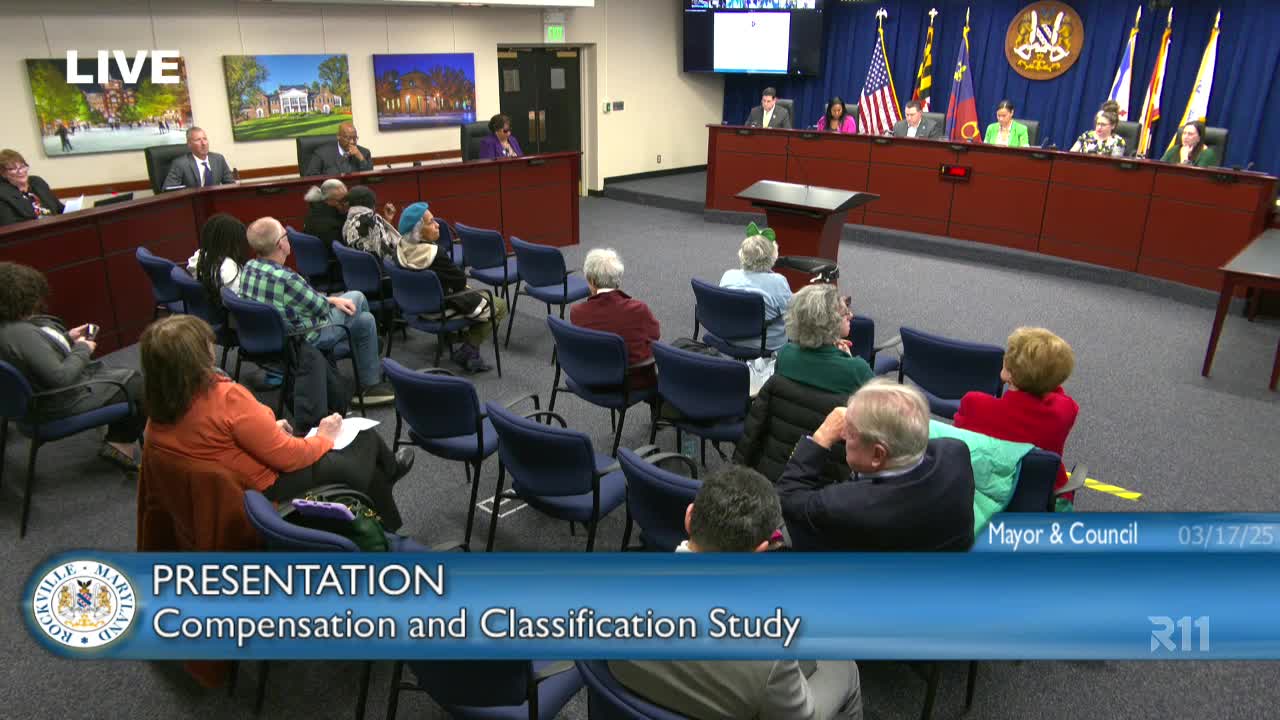
The City of Rockville presented an overview of its recent compensation and classification study during the March 17 council meeting, outlining findings, recommended pay philosophy and next steps as staff and the consultant recommended refinements to job documentation and a targeted pay‑range adjustment strategy.
Susan Seelig introduced the city’s study and the Bolton Partners team; Bolton’s Dan Ritberger summarized the firm’s approach and conclusions, saying the study compared Rockville job classifications and pay ranges against a regional peer group and recommended aiming pay ranges toward the 60th percentile of the market.
“Targeting the 60th percentile allows you to attract a higher caliber of talent,” Ritberger said, describing the firm’s market methodology and the mixed results across employee groups. Bolton found pay ranges slightly below market overall and recommended limited redesign of the grading system, improved job documentation, and communication of total rewards.
Key technical findings presented: - The city-wide midpoint of pay ranges stood roughly 3.4 percent below the 60th‑percentile market benchmark on combined ranges; variance differed by structure (administrative, union, police, senior management). - Staff proposed including a 2.5 percent cost‑of‑living adjustment in the FY2026 budget and to provide, for employees identified as below market, adjustments capped at 7.5 percent in the recommended budget year. - Bolton recommended modernizing the point‑factor classification approach to a job‑family and career‑level model and improving job documentation.
Public comment and employee concerns: Gina Arnett, an engineer in Public Works who identified herself as a board member of the Association of Administrative Municipal Employees (AIM), said AIM had been promised a two‑week period to review a draft of the final report but received the final report via email instead. “Because of this, AIM has not been able to form a complete opinion on the study’s findings, as we simply didn't have the opportunity for participation that was initially promised,” Arnett said, urging the city to reaffirm commitments to employee engagement in policy changes that affect pay and classification.
Context and next steps: staff said the FY2026 recommended budget contains the 2.5 percent general adjustment and capacity to apply market corrections where the study indicates gaps; final decisions on how to implement individual adjustments will be part of budget adoption. Bolton emphasized that the study reflects a point‑in‑time market analysis and recommended additional steps to document jobs, refresh classification methodology and integrate any changes into city policies.