Get Full Government Meeting Transcripts, Videos, & Alerts Forever!
Get email alerts on the Historic Preservation topic
No spam. Unsubscribe anytime.
San Mateo council approves letter to state saying city will pursue local historic‑preservation process
Summary
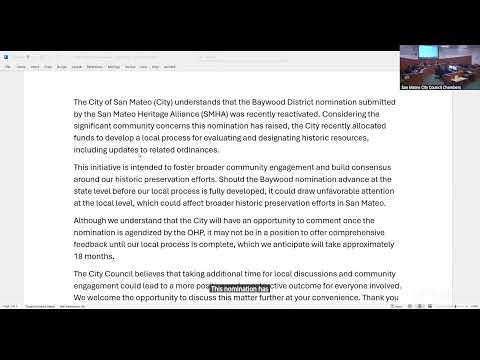
After nearly three hours of public comment, the San Mateo City Council voted 4-0 (one recusal) to send a letter to the California Office of Historic Preservation notifying the state that the city has initiated a local historic‑preservation process and setting an anticipated local timeline of about 14 months.
SAN MATEO, Calif. — The San Mateo City Council voted Monday to send a letter to the California Office of Historic Preservation (OHP) notifying the agency that the city has started a local process to update its historic‑preservation ordinances and context study and saying the city expects that local work to take about 14 months.
The vote came after roughly 14 speakers during a special meeting on the Baywood neighborhood nomination, a contentious item that drew residents who both support and oppose state consideration of Baywood as a historic district. The motion to send the letter carried 4-0, with one council member recorded as recused for the Baywood discussion.
The letter approved by the council — a version described in the meeting as the deputy mayor’s draft — states that the city “understands that the Baywood District nomination … was recently reactivated,” notes the council’s recent allocation of funds for local historic preservation planning, and says the city anticipates its local process will take approximately 14 months. The text reads in part: “The city council believes that taking additional time for local discussions and community engagement could lead to a more positive and constructive outcome for everyone involved. We welcome the opportunity to discuss this matter further at your convenience.”
Why it matters: Council members said the letter is intended to ensure OHP knows the city is pursuing its own, locally controlled process so that the city can provide comprehensive feedback once that work is complete. Supporters of the letter argued local review and updated ordinances could better reflect neighborhood preferences; opponents said the letter improperly seeks to influence an established state process and could delay homeowners’ access to state preservation incentives.
Public comment was strongly divided. Zev Simon, who identified himself as a builder, said the “word historic is inappropriate here,” adding he believed the nomination reflected a small, vocal group’s influence. “I build a home. I build it to be historic? In 45 years, my home will be historic? No, I just built a nice home,” Simon said. By contrast, Connie Weiss, speaking remotely, said “Truth matters” and urged the council to vote no to a deferral, saying a historic district is “an honor for the city” and provides financial incentives such as tax credits and Mills Act property tax programs for contributing homes.
Speakers representing or speaking on behalf of the San Mateo Heritage Alliance (SMHA) urged the council not to send the letter and to allow the state review to proceed. Lori Heater told the council the state process provides a formal comment period and that delay could deprive homeowners of access to rehabilitation funds. Other Baywood residents said they had been promised a local process and felt the council’s move to notify OHP was a breach of that understanding.
Council debate focused on competing objectives: protecting property owners’ ability to modify homes versus preserving neighborhood character and ensuring a well‑informed local process. “This is a very gentle letter,” Council member Nicole Fernandez said, adding she believes the council “is not frowning on the historic district occurring” but wants the city kept “in the loop” while it builds a local process. Deputy Mayor Lorraine’s draft was described during deliberations as a compromise that removed stronger deferral language from an earlier version.
Council members and staff discussed the timeline for local work. City staff told the council that an updated ordinance and related context statement could be ready for council action in about 12 months, with a 14‑month window allowing two months for implementation. Council discussion settled on an anticipated 14‑month schedule for the letter sent to OHP.
The council also noted procedural constraints: the state’s process includes a period after an application is agendized for the State Historic Resources Commission during which the city may submit comments; that comment window typically begins when the commission schedules the nomination for hearing. City staff said the application was not yet scheduled for a commission hearing at the time of the meeting.
The letter will be transmitted to the state; the OHP and the State Historic Resources Commission retain authority over scheduling and whether to act on the nomination. Council members said the item and the broader ordinance update will return to upcoming meetings, and the city expects further community engagement as work proceeds.
The special meeting concluded after the vote and the council recessed to a regular meeting.