Get Full Government Meeting Transcripts, Videos, & Alerts Forever!
Get email alerts on the Brown Act topic
No spam. Unsubscribe anytime.
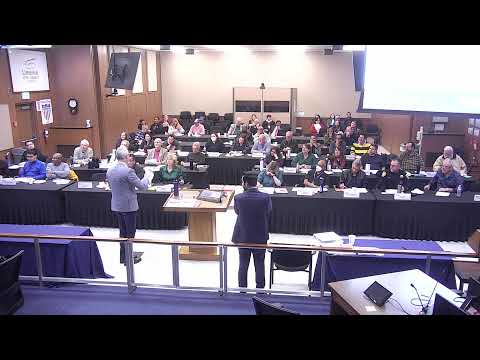
City attorneys review Brown Act rules on public meetings, serial communications and social media
Summary
The training included a detailed review of the Brown Act: agenda posting requirements, what constitutes a meeting, serial‑meeting risks, remote participation rules and new statutory guidance on social media interactions between members of legislative bodies.
Deputy City Attorney Luis Haro led a detailed review of the Brown Act, emphasizing that deliberations and actions by a local legislative body must occur at a public meeting, with notice and an opportunity for public comment.
Haro reviewed the statutory definition of a meeting — "any congregation of a majority of the members" to hear, discuss or deliberate on an item within the body's jurisdiction — and warned that deliberative serial communications, including emails, texts and social‑media interactions, can create unlawful meetings.
He illustrated common serial‑meeting patterns ("daisy chain" and "hub and spoke") and advised that staff communications should be coordinated to avoid inadvertently creating a chain of communications that reaches a quorum.
Haro also summarized agenda posting rules (72 hours for regular meetings; 24 hours for special meetings), requirements for agenda descriptions that meaningfully inform the public, and limited exceptions where an agency may act on unagendized matters in emergency situations or by two‑thirds urgency vote.
Remote participation rules were explained, including the traditional teleconferencing approach (posting the remote location on the agenda and making it accessible to the public) and the newer AB 2303 framework that permits limited teleconference participation for specified reasons (emergency or just cause) with two‑way audio‑visual and webcasting and restrictions on frequency of remote attendance.
The presentation covered AB 992, which provides statutory guidance for social‑media interactions: officials may use social media for informational purposes but must avoid using it to discuss official business in ways that would create a serial meeting. Haro cautioned officials not to "like," share or otherwise engage with another member’s post about pending agency business in a way that could be treated as deliberation.
Haro recommended routine practices for compliance: check the roster of contacts before discussing city business with colleagues, route meeting scheduling through staff, avoid "reply all" on multi‑member emails and seek city attorney advice when in doubt.