Get Full Government Meeting Transcripts, Videos, & Alerts Forever!
Get email alerts on the Conflicts Of Interest topic
No spam. Unsubscribe anytime.
City attorneys outline conflicts‑of‑interest rules, highlight Levine Act contribution limits
Summary
Deputy City Attorney Luis Haro reviewed financial and contractual conflict rules under the Political Reform Act, Government Code Section 1090 and the Levine Act, including thresholds for disclosure and recusal.
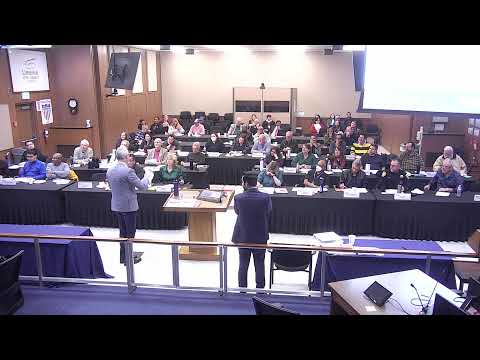
Deputy City Attorney Luis Haro walked attendees through the primary state and local laws that govern financial conflicts of interest, contractual conflicts and recent changes concerning campaign contributions.
Haro described the Political Reform Act framework and the four‑step FPPC analysis that officials and staff use when evaluating whether a decision has a disqualifying financial effect. He said material financial interests can arise from business entities and real property (thresholds commonly referenced at $2,000) and from proximity rules that look at property within 500 to 1,000 feet of a decision’s subject.
"Know your financial interests," Haro advised. He said officials should disclose potential conflicts, not participate in decisions when conflicts exist and seek formal FPPC opinions in close cases.
Haro reviewed Government Code Section 1090, which bars public officials from participating in contracts in which they have a financial interest. He stressed the statute’s distinct effect on legislative bodies: under Section 1090, a conflict can preclude the entire legislative body from entering into a contract unless a specific exception applies.
The presentation included the Levine Act reform that treats campaign contributions as disqualifying interests for certain decisions. Haro explained the current $500 threshold: elected officials who receive campaign contributions in excess of $500 from a party or participant in a decision within the prior 12 months may need to return the contribution, disclose it and recuse, and that some exemptions now apply for competitively bid contracts and contracts under $50,000.
Haro and Gugans also discussed local rules that supplement state law, including Santa Clara Municipal Code provisions governing campaign conduct and city manager directives affecting employee conduct.
Practical advice emphasized by the attorneys included: review agendas before meetings, contact the city attorney’s office if a close call arises, and when uncertain, recuse. Haro said recusal should occur before participating in the matter — not after staff presentations or questions — and he used hypothetical scenarios to show how late participation can create violations or appearance issues.
The attorneys also discussed post‑employment lobbying prohibitions that bar senior officials from advocating for compensation before their former agency for one year after leaving office. Attendees were directed to consult both state law and local municipal code sections for operation‑specific rules.