Get Full Government Meeting Transcripts, Videos, & Alerts Forever!
Get email alerts on the Business Improvement Districts topic
No spam. Unsubscribe anytime.
Hartford council holds hearing on Parkville Special Services District; supporters praise cleanup and safety plan, residents raise governance concerns
Summary
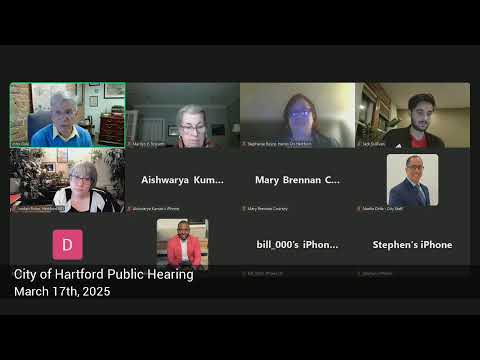
The Hartford City Council held a public hearing Monday on an ordinance to create the Parkville Special Services District, a business improvement district (BID) that backers say would fund cleaning, marketing and public-safety services in the Parkville neighborhood.
The Hartford City Council held a public hearing Monday on an ordinance to create the Parkville Special Services District, a business improvement district (BID) that backers say would fund cleaning, marketing and public-safety services in the Parkville neighborhood.
Supporters told the council the BID would provide a dedicated revenue stream for neighborhood services and help the area manage recent growth; one registered commenter said the ordinance as written gives too much voting weight to large property owners and could divert community-benefit funds away from smaller nonprofit providers.
The ordinance, introduced by the mayor’s office and described in a cover letter read by Councilman John Gale, would amend chapter 28 of Hartford’s municipal code to authorize the Parkville BID under Connecticut’s general statutes. Proponents said the district would cover roughly 400 taxable properties within boundaries that run north to West Boulevard and Capitol Avenue, east near Park and Pope Park, south to Flatbush Avenue and west to Prospect and Newpark avenues. Funding would come from a special assessment on taxable properties; proponents estimate roughly $180,000 annually, using an initial levy described in the ordinance as a two-mill assessment for fiscal year 2025.
Mary Coursey, who said she worked with the Parkville Business Association and CRDA to develop the proposal, told the council the BID is intended to “enhance the neighborhood’s economic vitality and quality of life” and to “complement, not replace, already existing city services.” She summarized the governance plan and safeguards in the ordinance, saying the board would have 11 members — six property owners, two business tenants, and three ex officio seats (two mayoral appointees and one appointee from the Parkville NRZ) — and that property owners would vote in a referendum required by the ordinance. “I respectfully request your support for this ordinance allowing property owners to vote on this important initiative,” Coursey said.
Other supporters described street-level problems they expect the BID to address. Jack Sullivan, who identified himself as the vice president of the Parkville NRZ and a Parkville business owner, said the neighborhood has seen improvements but still struggles with litter, discarded needles and street-level drug use. “I see this Business Improvement District as a tool to harness the forces that are propelling that change,” Sullivan said, adding the BID would contract outreach and cleanup services similar to downtown arrangements.
Jordan Poland, identified as the executive director of the Hartford Business Improvement District, said the downtown BID is prepared to share resources and operational know-how to help the new district get started. Stephanie Boyce of Hands On Hartford and business owners including Steven Casano also spoke in support, stressing potential benefits for residents and small businesses.
Not all registered speakers supported the ordinance as written. David Morin, who identified himself as president of the Parkville Revitalization Association, said he was listed as supporting the proposal when he signed up but that he opposed the ordinance in its current form. Morin said the voting structure in the ordinance — which assigns one vote per property under the schedule he cited — could give disproportionate influence to large property owners and condo-unit listings. He also raised questions about how “community benefit” funds tied to larger projects or grants would be distributed, asking whether those funds could end up controlled by the special services district rather than shared with existing smaller nonprofits in Parkville. “We believe in the zeal to start new building projects. . . . This does not spell out at all how the community benefit portion will reach other nonprofits in our area,” Morin said.
Council members and staff clarified procedural next steps during the hearing. Councilman Gale told listeners that after the public hearing the ordinance will be considered by the Planning, Economic Development and Housing Committee (PEDH), which is scheduled to meet April 2 at 5:30 p.m.; committee review precedes any final council vote. Councilman TJ Clark encouraged continued outreach between proponents and concerned residents to resolve questions about governance and grant distribution.
The ordinance, as described in the mayor’s cover letter, includes these key provisions: a property-owner referendum requiring majority approval by both number of owners and assessed value; an opt-out for owners of one-, two- and three-family homes; semiannual billing through the city tax process; annual financial reporting and insurance requirements; and initial operations that would begin once funds are collected. Proponents said, if approved at referendum, the BID’s board would be seated within 30 days and services would begin in the current fiscal year and ramp up as revenue is received.
The council closed the hearing and referred the matter to the PEDH committee for further review and public comment. The committee meeting is the next scheduled opportunity for additional input and possible ordinance revisions before the council considers final action.