Get Full Government Meeting Transcripts, Videos, & Alerts Forever!
Get email alerts on the Capital Improvement Plan topic
No spam. Unsubscribe anytime.
Planning commission finds 2026–2031 capital improvement plan conforms with general plan
Summary
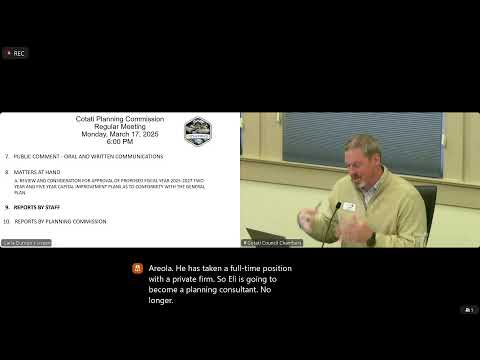
The Cotati Planning Commission voted unanimously to find the proposed fiscal years 2026–2031 Capital Improvements Plan (CIP) in conformity with the city—s General Plan after a presentation and public questions about project scope, sequencing and funding.
The Cotati Planning Commission on March 17 adopted a resolution finding that the City—s proposed fiscal years 2026–2031 Capital Improvements Plan conforms with the city—s General Plan. The vote was recorded as three yeas: Commissioner Gilardi, Commissioner Burman and Chair Moffitt.
The finding of conformity is procedural: staff and commissioners said the Planning and Zoning Law requires the commission to determine whether listed capital projects align with General Plan goals. Craig Scott, the city—s public works director and city engineer, told the commission the CIP lists 40 projects across departments and provides a six-year (2026–2031) view; the first two years are intended to be matched to the biennial budget and proposed funding sources before the City Council. Scott said the list is used to coordinate long-range work, avoid undoing recent improvements and to sequence projects such as water, sewer and paving.
Scott outlined projects by department: drainage (trash capture devices on downtown storm pipelines); building (new roof for the police building and Civic Center parking improvements); parks (six projects including Civic Center Park, Putnam Park and Sunflower Park, several about 65% through design); streets (about 17 listed projects including traffic signals, sidewalk gap closures, annual street preservation and Gateway signage); sewer (lift station assessments and collection system renewal/replacement); and water (well remediation and new well, distribution-system monitoring, West Sierra tank recoating and a multi‑year Cypress tank replacement and related pipelines and booster pumps). Scott said some projects are ready for near-term design and construction, while others are placeholders out to 2031.
Commissioners and public commenters pressed staff on sequencing, funding and technical details. Commission members emphasized coordination to avoid repeatedly cutting into recently paved streets and asked whether sewer and water work would be scheduled to coincide with repaving. Scott replied that sequencing is a purpose of the CIP and that recent projects (West Sierra Avenue, Redwood Drive, Cypress Avenue) were completed with federal money.
Several commenters raised financing and implementation concerns. A speaker asked how much of the CIP depends on federal grants and noted that some awarded grants are at risk. Scott confirmed the city has recently completed federally funded projects and said the city is awaiting the next SCTA (Sonoma County Transportation Authority) round; he cited an awarded ADA/class‑4 bike lane and ADA transition plan grant valued at about $175,000 that he said is now at risk. Scott also confirmed that a $1 million federal earmark for the Highway 116/West Cotati Avenue intersection remains available at the time of the meeting.
The police building roof drew specific attention. Scott said the roof is nearing 20 years of service and has experienced an increasing number of leaks; staff recommended replacement after repeated patching failed to stop leaks. Commissioners asked whether prior work was defective and whether the city would hire project managers and inspectors; Scott and other staff noted standard public‑works procedures (project management, inspection, warranties where applicable) are used for public projects. A public commenter suggested hiring a consultant to investigate the prior roof installation to avoid repeating problems.
Scott and commissioners also discussed project illustrations and public outreach. Scott said some figures in the materials are illustrative and not the latest design; he pledged to post updated plan milestones to the project site (ClearGov) when available, and estimated that some design materials could be published by mid‑April. He reiterated that the commission—s action tonight addressed conformity to the current General Plan rather than setting funding priorities — those decisions are presented to the City Council with proposed funding sources for the first two years.
After questions, Commissioner [mover not specified on the record] moved to adopt a resolution finding the CIP conforms with the city—s General Plan. The motion passed on a roll call vote: Commissioner Gilardi — yes; Commissioner Burman — yes; Chair Moffitt — yes.
Next steps described by staff: the commission—s conformity finding will go to the City Council with proposed funding sources for the first two years; Council may rearrange priorities based on available funding. Staff also noted an upcoming SCTA funding cycle in June and that some awarded projects may be affected by changes in federal funding availability.
The commission and staff exchanged several follow-up commitments: staff will post updated design plans when available, continue sequencing reviews to coordinate utilities and paving, and include energy‑opportunity analysis (solar/battery) in broader facility evaluations. The meeting record shows no further formal action on CIP priorities at this session.