Get Full Government Meeting Transcripts, Videos, & Alerts Forever!
Get email alerts on the Pests Spongy Moth topic
No spam. Unsubscribe anytime.
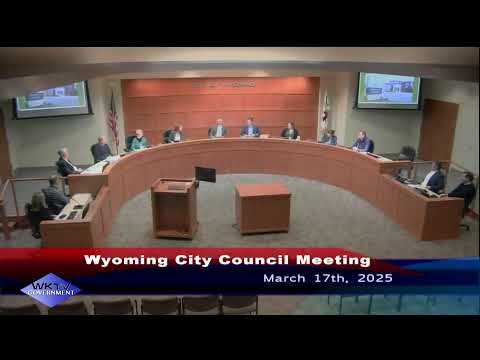
Wyoming council approves spongy moth suppression assessments after public hearing
Summary
City council declared necessity for aerial insecticide treatment and established two special assessment districts for the 2025 spongy moth suppression program after a public hearing and brief debate over cost allocation and park inclusion.
The Wyoming City Council voted to declare the necessity of an aerial insecticide spray for the city’s 2025 spongy moth suppression program and to establish Special Assessment Districts (SADs) 205821 and 205822 to defray project costs.
The vote followed a public hearing in which one resident, Ron Cole of 1134 Loxley Drive SW, spoke in favor of treatment and urged that spraying occur when tree leaves are sufficiently developed for the application to be effective. “I hope that they spray when all the trees are leafed out enough that it actually works,” Cole said.
The action matters because the council authorized creation of the assessment districts that will assign some or all project costs to affected property owners rather than the city general fund. That allocation was a point of contention during council discussion, with at least one council member repeating concern that the cost should be spread citywide rather than assessed only to property owners in the treatment area.
City Manager John explained the program logistics and timing: staff and consultants monitor spongy moth larval activity, tree canopy development and weather to identify the ideal treatment window. He told the council that the city has shifted the takeoff site for aerial treatment to Gezon Park this year because of development at a previous site and that Kent County parks (including Palmer Park) are not part of the city’s 2025 treatment program. "For this year's 2025 Wyoming project, they [Kent County] are not contributing towards the cost of this project," John said.
Council debate touched on fairness and precedent. One council member said the council had discussed assessment versus citywide funding twice the prior year and noted the council split on the decision then. Another member said they were open to reconsidering how costs are allocated in future years and suggested bringing the topic to a retreat for broader discussion.
Council member De Krieger moved to adopt the resolutions; the motion was seconded (support recorded as "Passover" in the minutes). The roll call recorded a majority in favor with one dissent: Hill voted no; other members present voted yes.
The resolutions declaring necessity and establishing SADs were adopted at first action this evening; the council indicated implementation details and scheduling would follow in staff reports and notices to affected property owners.
Votes at the meeting showed the council moving forward with the 2025 aerial treatment under the assessment structure described in staff materials. Residents and property owners who live adjacent to treated parkland or in the mapped SADs will receive further information from the city regarding timing and any property-level assessments.
A follow-up item expected in coming weeks will include the formal assessment roll and schedule of rates for property owners within each SAD.