Get Full Government Meeting Transcripts, Videos, & Alerts Forever!
Get email alerts on the Land Use Rezoning topic
No spam. Unsubscribe anytime.
Council weighs traffic, density concerns for proposed Johnston‑Naylor redevelopment in North Mallard Creek
Summary
A rezoning request for a 13.29‑acre site on Johnston‑Naylor Road drew lengthy public comment and council questions about traffic, parking and neighborhood character. City staff recommended approval with outstanding transportation issues to resolve; proponents reduced unit counts and added setbacks and crossings.
Charlotte — City council members and planning staff on March 17 reviewed a rezoning petition for about 13.29 acres on Johnston‑Naylor Road in the North Mallard Creek area that would allow up to 45 attached dwelling units and related streetscape and pedestrian improvements.
Planning staff described the proposal as a N2A conditional request that would add townhome‑style and low‑rise multifamily units, commit to a 30‑foot setback from Johnston‑Naylor, a 25‑foot buffer adjacent to a school and park, and a pedestrian crossing with a rapid‑flashing beacon to improve access to nearby schools and open space. Staff recommended approval while noting outstanding transportation issues to work through.
The petition drew a sizable public turnout and a long public comment from neighborhood resident Michael Faust, who said decades of steady development and existing backups at the T‑intersection of Johnston‑Naylor and Mallard Creek Road have left residents concerned that adding roughly 1,000 projected daily vehicle trips will worsen an existing choke point. “Most mornings it backs up past the park,” Faust said. “This development is about a hundred yards from a T intersection with Mallard Creek… this will just add twice as many units at a choke point.”
Council Member David Mitchell pressed staff on trip figures. Staff responded that current use generates roughly 40 daily trips, the site’s entitlement would produce about 424 trips, and the proposed project would generate about 1,005 trips per day — below the city’s code threshold for requiring an individual traffic study but substantially larger than existing use. Jay Carpenter of the Charlotte Department of Transportation told council the corridor is largely built to its planned cross‑section and that there are no current plans for further widening; some pedestrian and signal projects are planned or underway.
The petitioner, representing Wilkes Asset Management, said the plan had been revised after community feedback to reduce density, increase the setback from Johnston‑Naylor, cap the number of rental units and add guest parking and open space. The developer also said the Mallard Creek Road widening is a funded project that will provide additional capacity further down the corridor.
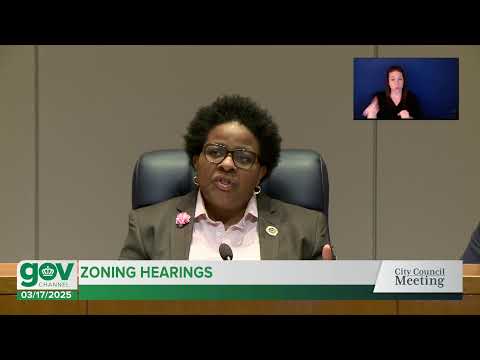
Council members voiced competing concerns: some said the petition meets the city’s rezoning standards and noted the petitioner’s concessions and proximity to activity centers; others reiterated resident worries about cumulative traffic impacts and urged continued coordination with NCDOT and community outreach. Councilmember LaWanna Mayfield and others said the community needs clearer timelines for corridor improvements before approving added density in affected pockets of the city.
The council closed the public hearing and, following discussion, voted to move the petition forward; the hearing was closed unanimously and staff will continue to work with the petitioner to resolve transportation and technical items before the final decision.
Ending — The petitioner and staff agreed to continue coordinating with neighborhood groups and CDOT on mitigation commitments and signal/crossing improvements. Council members said they intend to monitor cumulative development and regional traffic plans as the area continues to build out.