Get Full Government Meeting Transcripts, Videos, & Alerts Forever!
Get email alerts on the Sacred Settlements topic
No spam. Unsubscribe anytime.
Committee hears support and concerns for Sacred Settlements bill amendment; amendment adopted and bill laid over
Summary
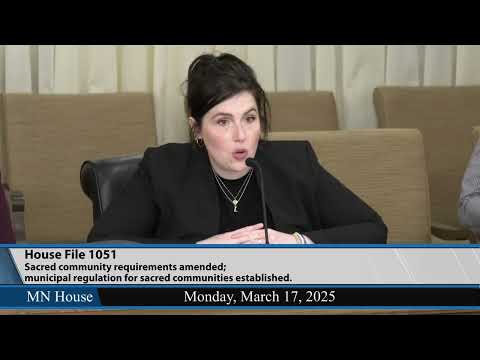
House Operations Committee members on March 12 took testimony on House File 1051, an update to the 2023 Sacred Settlements law that recognizes tiny-home "sacred settlements" operated by faith communities and sets standards for their safety and municipal oversight.
House Operations Committee members on March 12 took testimony on House File 1051, an update to the 2023 Sacred Settlements law that recognizes tiny-home "sacred settlements" operated by faith communities and sets standards for their safety and municipal oversight. The committee adopted an A3 amendment from the bill's author and laid the measure over for further drafting.
The bill's author said the A3 amendment "reflects my intentions" to preserve religious communities' ability to host tiny-home settlements while adding "guardrails" to address safety and municipal concerns. The author told the committee the amendment requires some level of electrical utility service to each micro-unit and seeks to limit how cities can impose licensing requirements.
The change is intended to be permissive: it would allow cities that already operate rental licensing programs to apply those licensing standards to settlements in order to address life-safety complaints, but the author and advocates said they are still negotiating the precise limits of any municipal license.
Heidi Nelson, city administrator for Maple Grove, told the committee that current state law provides "no state, county, or local licensing oversight" specifically for sacred settlements and that the city relies on its rental licensing process to address life-safety problems such as broken smoke detectors, unsafe steps and other habitability issues. "Without a rental license, there's very little a city can do to address a complaint," Nelson said, describing Maple Grove's practice of full inspections at licensing and every three years thereafter.
Daniel Lightfoot of the League of Minnesota Cities said the League helped negotiate the original statute and worked with Maple Grove and advocates on the amendment. He described the change as restoring municipal authority to apply rental licensing as an ongoing enforcement tool to address life-safety issues that may not be explicitly listed in the Sacred Settlements statute.
Several neighborhood and faith leaders testified about their experiences operating or living next to settlements. Mickey Elfenbein, president of the Chapelwood Homeowners Association, said roughly 300 homeowners near a proposed Maple Grove site had not felt adequately engaged and asked the committee to require "meaningful community engagement" before settlements proceed. Leaders from faith groups and operators of existing settlements emphasized their models are community-based and not typical landlord-tenant relationships.
Representatives of existing settlements described small, intentionally mixed communities. Meredith Campbell said Mosaic Christian Community's settlement on St. Paul's East Side includes six tiny homes, "four of those homes are for neighbors who have experienced chronic homelessness, and two of those homes are for intentional neighbors." Michael Stetzler, whose Prince of Peace congregation hosts three tiny homes, told lawmakers: "These people are part of our family. We are living in community with them." Several residents from Mosaic described improved stability, access to services and community ties after moving into tiny homes.
Advocates for the settlement model expressed concern that broad rental-licensing language could be used to delay or impede faith communities' efforts. Ricky Campbell, who represents Settled (an organization that supports church-based tiny-home communities), said the group is concerned that rental licensing programs historically have been used to block affordable housing and asked for narrow, targeted language.
Committee members asked whether any municipal licensing would be administrative or require public hearings. Nelson and Lightfoot said existing conditional use permit (CUP) and permitting processes remain available for initial approvals and neighborhood input; the licensing concept discussed during testimony would focus on an ongoing enforcement mechanism to address life-safety issues for units after initial approval.
Representative Coulter asked whether the amendment envisioned a traditional rental license; the author and Lightfoot said the plan is to limit any licensing authority to landlord-tenant provisions in Minnesota Statutes chapter 504B (commonly referenced in committee as "504B" or "504"). The author said advocates and cities were still negotiating precise language and that an updated draft was being prepared.
The committee adopted the A3 amendment (voice vote recorded in committee; explicit tally not recorded in the transcript) and then laid the bill over to allow further drafting and stakeholder work. Multiple members asked that the public-engagement piece remain part of the discussion before the bill returns to committee.
The hearing included procedural discussion about public testimony deadlines and in-person sign-up. Representative Freiberg raised concerns that the public received the agenda notice with less than 24 hours to sign up; the chair said the committee would follow the earlier-stated rules after staff reported "threats to staff" at other meetings and advised adherence to the sign-up deadline.
The committee did not take a final floor vote on the bill; the author said she would continue to refine the amendment with advocates and cities before returning it for further committee consideration.
Ending: The committee recessed after laying the bill over; supporters and opponents said they would continue negotiations on narrow licensing language and public-engagement provisions ahead of the bill's next appearance.