Get Full Government Meeting Transcripts, Videos, & Alerts Forever!
Get email alerts on the Elections Appointments topic
No spam. Unsubscribe anytime.
Lynnwood mayor, council debate vetting and process after candidate withdrawal; special business meeting set
Summary
Mayor Frizzell said troubling information about a finalist led to that person’s withdrawal and reminded council it must appoint a replacement by April 5; councilors debated background‑check options and whether to reopen the application process or proceed with two remaining nominees.
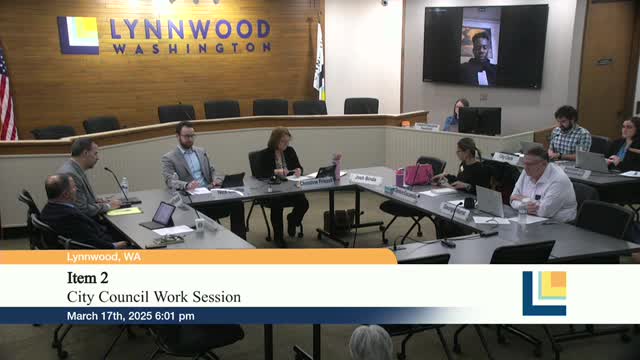
Mayor Christine Frizzell opened the March 17 work session by addressing a “disturbing” set of disclosures that emerged after councilors had shortlisted candidates to fill a council vacancy, saying the candidate withdrew and that the council had followed Resolution 2024‑08 in the appointment process.
The mayor told council that the city must appoint a replacement by April 5 or Snohomish County will make the appointment. Council members spent more than an hour discussing how to vet applicants going forward and what process to use before a final vote.
Background‑check options summarized by staff included: a police/criminal-record check that typically returns results in 24–48 hours for a small fee, a full background investigation used for department directors (performed by an outside consultant, 2–4 weeks, estimated $5,000–$7,000), and a subscription‑based open‑source search tool (TLOxp, from TransUnion) used by the police department that aggregates public records and social‑media footprints. Assistant City Administrator Julie Moore noted that application materials for elective offices and council vacancies are subject to public disclosure under Washington public‑records law (RCW) and that the city’s police CJIS access protocols govern criminal information and criminal‑justice data access.
Council debate: council members were divided on how far to go. Some argued for limited, rapid checks (criminal background or TLOxp/CJIS searches) and for asking applicants to disclose social‑media handles and relevant background items on their application forms. Others warned such checks can be weaponized, raised fairness and privacy concerns and noted that voters do not subject elected candidates to the same screening. Council Member Decker said council has a duty to conduct due diligence when it is making appointments on behalf of residents and suggested running checks only on finalists; Council Member Coelho suggested asking applicants to provide social‑media handles as a first step.
Application status and next steps: staff reported they had contacted the four remaining candidates. Two — Robert Lutweiler and Forrest Baum — responded that they remain interested; two — Chelsea Wright and Nazlash Gary — withdrew their names. City staff said they had not performed formal vetting beyond clerk checks of residency and voter registration. Several council members debated whether to reopen the application process, bring additional previous applicants back for new interviews, or proceed with the two remaining candidates. Several council members warned changing the process midstream could trigger further delays and risk missing the April 5 deadline.
Action scheduled: Council leadership announced a special business meeting to be held at 6 p.m. to allow the council to vote on whether to change the established appointment rules and to decide how to proceed with the vacancy. Staff and council also discussed the practical steps for any checks ordered (who would run them, recordkeeping and whether reports would become public records). No final vetting protocol was adopted during the work session.
The council directed staff to provide the background‑check options and to confirm candidate availability for interviews; several members offered to participate in outreach and to help recruit interim applicants if the council reopens the process.