Get Full Government Meeting Transcripts, Videos, & Alerts Forever!
Get email alerts on the Zoning Appeals topic
No spam. Unsubscribe anytime.
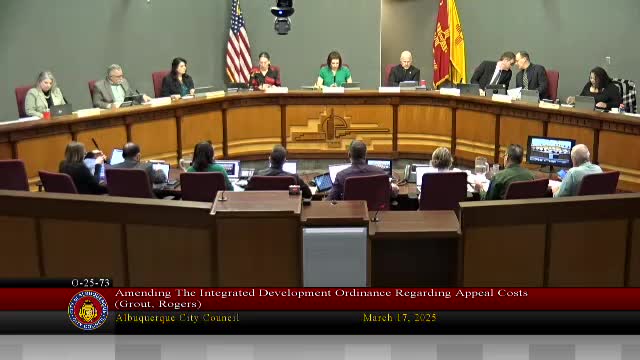
Council narrows appeal-cost provisions after hours-long debate, approves amendment capping fees and exempting low-income appellants
Summary
After extended debate and multiple amendments, Albuquerque City Council passed O-25-73 amending the Integrated Development Ordinance to cap appeal-related cost awards at $1,000 and to exempt individual appellants or neighborhood entities meeting hardship or social-vulnerability criteria; the final vote was 6'to—3.
The Albuquerque City Council voted 6'to—3 on March 17 to amend the city's Integrated Development Ordinance (IDO) to limit appeal-related cost awards and add exemptions for low-income appellants and certain neighborhood entities.
The measure, O-25-73, was introduced by Councilors Grout and Rogers as a response to concerns from neighborhood groups that legal and attorney costs can bar ordinary residents from defending neighborhood interests in land-use appeals. Councilor Grout opened the final-action discussion saying he sponsored the ordinance to respond to "what I heard from neighborhood associations and neighborhoods" who are burdened by legal fees.
The council approved a sequence of amendments during the meeting: - Amendment 1 (moved by Councilor Lewis; seconded by Councilor Champine) imposed a $1,000 cap on costs and fees recoverable by a prevailing party; the amendment passed 6'to—3. The amendment also retained the land use hearing officer's (LUHO) authority to make specific findings about fees for the council record. - Amendment 2 (moved and seconded by Councilor Lewis and Councilor Champine) removed certain whereas clauses from the ordinance text; it passed 5'to—4. - Amendment 3 (moved by Councilor Baca, seconded by others) added an exemption: the $1,000 cap "shall not apply to any individual appellant that demonstrates hardship, low income, or indigent status, or entity appellant that has a majority of its area within an area that has an overall score of 50 or greater on the City of Albuquerque Social Vulnerability Index." That amendment passed 5'to—4.
During debate, councilors and public commentators raised competing concerns. Supporters argued the change would reduce frivolous appeals used to delay housing and development and would help projects move forward; opponents warned a new fee could chill legitimate appeals by renters and low-income neighborhoods. Councilor Pena said he was concerned about low-income communities: "The $1,000 is just too high for especially some of those...neighborhoods," he told colleagues and asked for explicit hardship protections, which the final amendment addressed.
Councilors also discussed process fairness and transparency; several public commenters urged that the public should see final amended versions before the meeting. After the series of amendments, the council moved to final action on the ordinance as amended and approved O-25-73 on a 6'to—3 vote.
What the ordinance does: As amended, O-25-73 (1) sets a one-time $1,000 cap on costs and fees awards recoverable by the prevailing party in a land-use appeal (as assessed by the LUHO and reflected in the LUHO's report); and (2) provides exemptions for individual appellants who demonstrate hardship/indigence and for neighborhood entities whose geographic area scores 50 or greater on the city's Social Vulnerability Index.
Why it matters: The ordinance changes the financial stakes of filing land-use appeals in Albuquerque, aiming to discourage delay-based appeals while preserving access for low-income residents and socially vulnerable neighborhoods. Supporters say it will reduce project delays and litigation costs; opponents worry it could reduce accountability and limit community oversight of development decisions.
Provenance: Debate and the votes on each amendment and the final ordinance appear throughout the council meeting record; the LUHO's role, amendment language, and votes were recorded on the March 17 transcript.