Get Full Government Meeting Transcripts, Videos, & Alerts Forever!
Get email alerts on the Property Taxes Revaluation topic
No spam. Unsubscribe anytime.
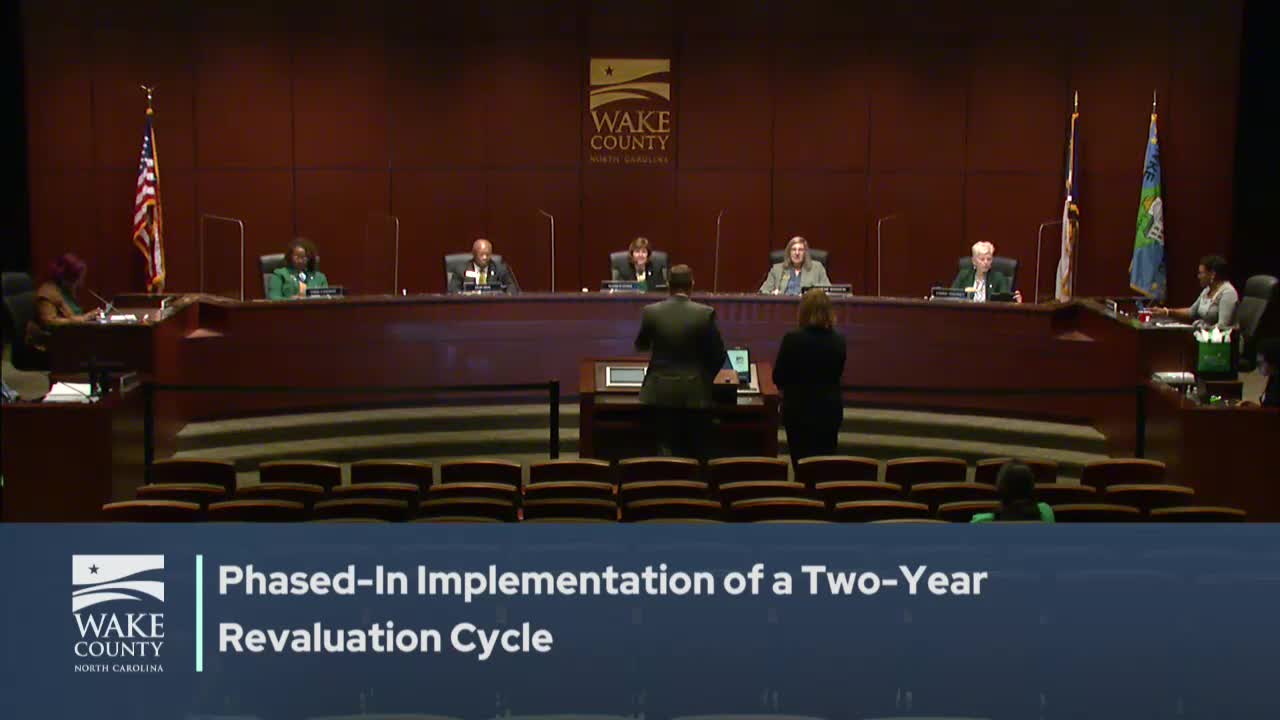
Wake County Board votes to shorten property revaluation cycle to every two years starting after 2027
Summary
The Wake County Board of Commissioners voted to advance the next countywide revaluation to Jan. 1, 2027, and to move to a two-year revaluation cycle thereafter, a change county staff says will reduce "sticker shock" and align assessed values closer to market prices.
The Wake County Board of Commissioners voted March 17 to advance the next countywide property revaluation to be effective Jan. 1, 2027, and to move afterward to a two‑year revaluation cycle.
County Tax Administrator Marcus Kinrade told commissioners that Wake’s rapidly growing parcel base and large valuation swings prompted the recommendation. "We propose conducting the next revaluation on a 3 year cycle, effective 01/01/2027, and then moving to a 2 year cycle effective on the odd years, 2029," Kinrade said. He said more frequent revaluations will align assessed values closer to market values and help mitigate large spikes in individual tax bills.
Kinrade summarized recent valuation history to explain the change. Wake’s taxable base rose from roughly $180 billion before the 2024 revaluation to $272.4 billion after it—an increase of about 51% on a four‑year cycle. He said growth since 2016 added the equivalent of one county the size of Alamance, with roughly 75,000 new parcels over nine years. "If we want to dissect that 2024 revaluation a bit more...we saw a 51% increase on a 4 year cycle," Kinrade said.
The tax office also reviewed appeal activity from the 2024 revaluation. Deputy Tax Administrator Nicole Kreiser described outreach and appeal handling: staff ran community meetings, partnered with community organizations, and used online tools and media to reach residents. At the informal-review level 61.7% of appeals resulted in no change and 34.9% were decreased; at the formal Board of Equalization and Review level 55.1% saw no change and 38.3% were reduced. Kinrise said the office carried 977 appeals into 2025 and expected to finish most by the end of March.
Officials described technology and staffing investments to support more frequent revaluations. Kinrade said the office uses SAS analytics and nightly sales-data feeds, plus lower-altitude aerial imagery and oblique photography, to detect property changes more often without extensive field visits. "We push them our complete data set and our complete sales file every night," he said of the SAS partnership. County staff said no new positions were requested for FY26 and that existing resources and contracts position them to perform revaluations more frequently.
Commissioners asked about public communication and municipal coordination. Kinrade and Kreiser said the tax office has an outward-facing "revenue neutral" calculator and will redesign tax bills to separate county and municipal amounts and list municipal customer-service contacts. "I think it's important...even to put that information in the tax bills," Kinrade said.
After public discussion and questions from multiple commissioners about outreach and the impact on homeowners versus new construction, the board adopted a resolution to advance the next revaluation to Jan. 1, 2027, and to conduct subsequent revaluations on a two‑year cycle. The motion passed by voice vote with no recorded roll-call tallies in the transcript.
Implementation notes: county staff said they have already begun fieldwork anticipating a 2027 project and will continue outreach, maintain appeal-processing capacity, and update the public tools used in prior cycles.