Get Full Government Meeting Transcripts, Videos, & Alerts Forever!
Get email alerts on the Workforce Tax Incentive topic
No spam. Unsubscribe anytime.
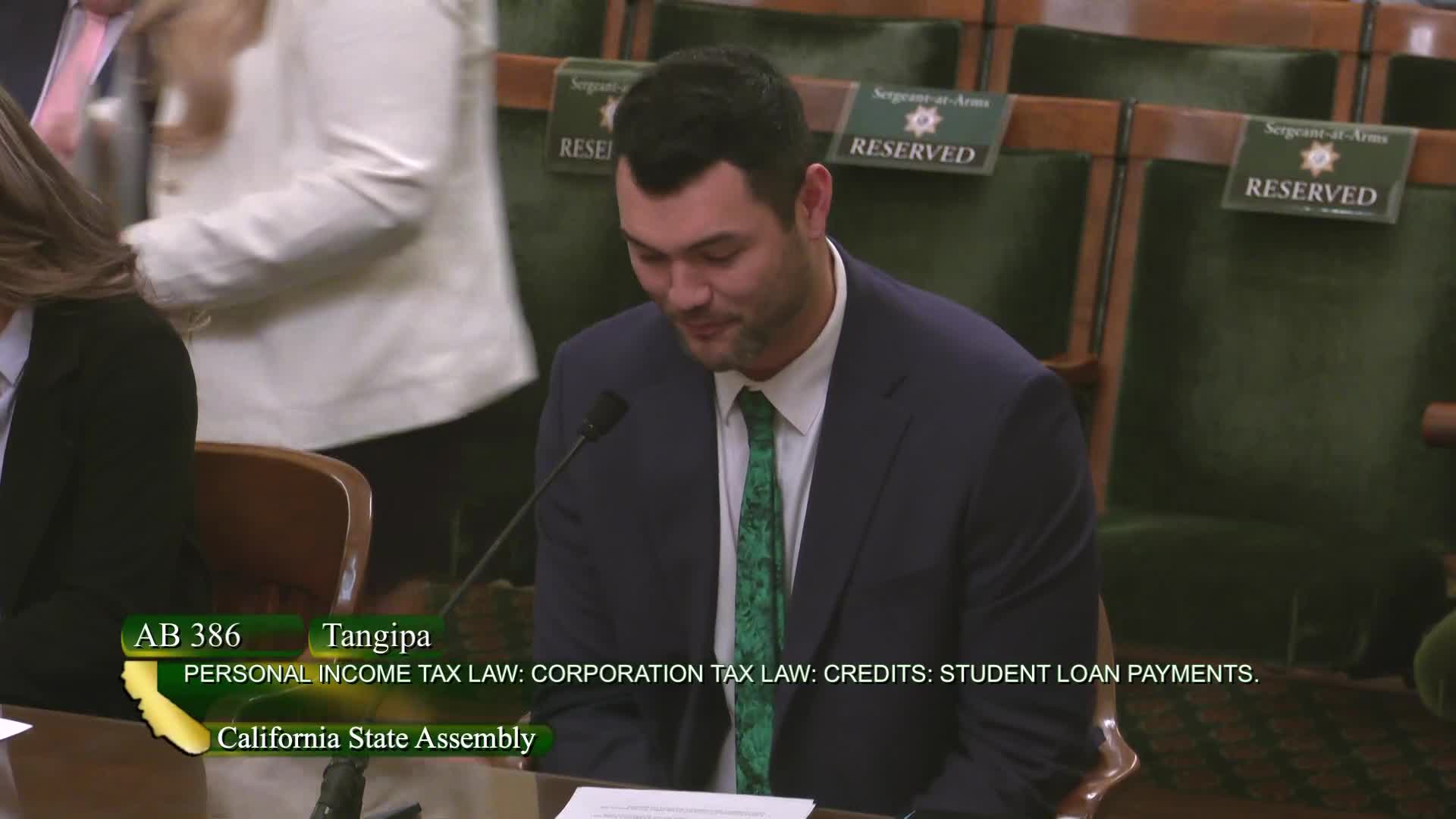
Committee hears AB 386 to create tax credit for businesses that repay employee student loans; opposition seeks allocation criteria
Summary
AB 386 would give businesses a tax credit (up to $3,000 per employee per year) for assisting full‑time employees with student loan repayments, with supporters saying it would help retain graduates.
Assemblymember Tangipa introduced AB 386, which would establish a state tax credit for businesses that assist full‑time employees with student loan repayments. Under the author’s proposal the credit is $3,000 per employee annually, effective beginning in 2026; an aggregate program cap of $25 million was discussed in the analysis.
Supporters, including SHRM California and a Fresno State student, argued that the incentive could help employers retain young professionals and address student debt‑related workforce retention challenges. "This bill is more than policy. It's a commitment to California's future and a creative solution to attack both student debt and the employment crisis," said Tangipa in presenting the bill. Patricia Leyva of SHRM California testified that tuition assistance and loan repayment incentives help employers compete in a high‑cost labor market; Carly Hall, a Fresno State junior, said loan relief would influence whether graduates remain in California.
The California Tax Reform Association testified in respectful opposition, raising concerns that the bill lacks allocation criteria and would award credits on a first‑come, first‑served basis, and that the Franchise Tax Board may be ill‑suited to make allocation prioritization decisions. Committee members, including Assemblymember McKenna, encouraged the author to work with opponents to develop allocation criteria and administrative approaches. The bill was referred to the committee suspense file for further consideration.