Get Full Government Meeting Transcripts, Videos, & Alerts Forever!
Get email alerts on the Consumer Protection Restitution Fund topic
No spam. Unsubscribe anytime.
Senate committee advances plan for consumer restitution fund capped at $1 million
Summary
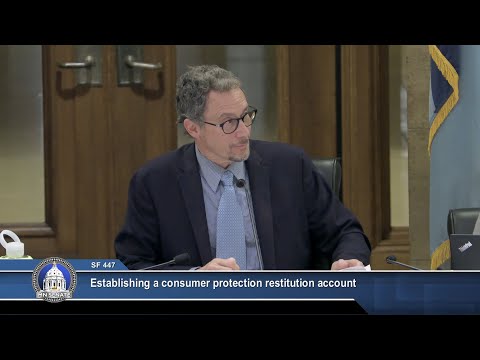
The Minnesota Senate Judiciary and Public Safety Committee on March 17 advanced Senate File 447, a bill to create a consumer protection restitution account designed to pay restitution to Minnesota victims in cases where defendants cannot satisfy court-ordered awards.
The Minnesota Senate Judiciary and Public Safety Committee on March 17 advanced Senate File 447, a bill to create a state consumer protection restitution account intended to help victims recover money when defendants are insolvent or otherwise unable to pay.
The measure, sponsored by Senator Rest and co-authored by Senators Carlson, Curran, Klein and Doornick, was sent to the Senate Finance Committee after the committee adopted an author amendment (A7) that made technical and tax-year clarifications and rejected a separate amendment (A6) that would have changed data-classification and transparency rules tied to the fund.
Supporters say the account would channel a portion of monies already collected in consumer enforcement actions into restitution for Minnesota victims who otherwise would receive nothing. Professor Prentiss Cox, a University of Minnesota law professor and former assistant attorney general, told the committee that the bill would place "50% of that money up to a million dollars a year into the restitution fund." Cox said money could only be paid from the account to satisfy court-ordered restitution owed to Minnesota consumers when the defendant cannot or will not pay.
The bill does not alter courts' authority to order restitution, Cox said, and it includes a reporting requirement: a new subdivision would require the attorney general to submit an annual report identifying cases that moved money into or out of the fund. Cox also confirmed a provision in subdivision 10 that would bar a private right of action “with respect to payment from the account or administration of the account.”
A victim who testified, Helene Johnson of Golden Valley, described losing about $15,000 to an alleged dental fraud and urged lawmakers to consider the bill so future victims have a path to recovery. "There are people like me that are actually victims and had nothing to do with it," Johnson said.
Committee members pressed for detail on how awards would be administered and who would decide distributions. Senator Anderson asked why court orders were not explicitly named in some administration provisions; Cox said courts already order restitution and the attorney general carries out discretionary administrative tasks under those orders. Several senators — including Senator Crook and Senator Kerwin — voiced concerns about transparency and the amount of discretion the attorney general would have in distributing funds. Kerwin cited court decisions affecting data access and asked whether public oversight would be adequate.
Senator Carlson moved adoption of the A7 amendment; the committee adopted it by voice vote. Senator Crook moved a separate A6 amendment that would have classified certain administrative and policy communications about the account as public data to increase transparency; the amendment failed after discussion and testimony from the attorney general's deputy consumer protection lead, Jessica Whitney, and Matt Ealing of Minnesotans for Open Government. Whitney said the Attorney General's Office would need time to review the amendment and raised privacy concerns for individuals whose data might be implicated.
After debate, Senator Carlson moved that the committee recommend Senate File 447 as amended to pass and be re-referred to the Finance Committee; the motion prevailed on a voice vote. The committee did not record roll-call tallies in the hearing transcript.
Why it matters: Supporters said the measure would create a narrowly targeted safety net for consumers ordered restitution by courts but who cannot collect it from defendants. Opponents and some county and transparency advocates warned that the bill creates an account administered by the attorney general with discretion that should be accompanied by fuller public reporting and clearer limits on administrative authority.
The bill's next step is consideration by the Senate Finance Committee.