Get Full Government Meeting Transcripts, Videos, & Alerts Forever!
Get email alerts on the Domestic Violence Sentencing topic
No spam. Unsubscribe anytime.
Connecticut advocates press Judiciary Committee to let trauma inform sentencing for domestic violence survivors
Summary
Survivor advocates, nonprofits and specialists urged the Judiciary Committee to pass Senate Bill 15‑02, which would let judges and parole authorities consider domestic violence, sexual assault, stalking and trafficking as mitigating or contributing factors when sentencing or reviewing sentences for people already incarcerated.
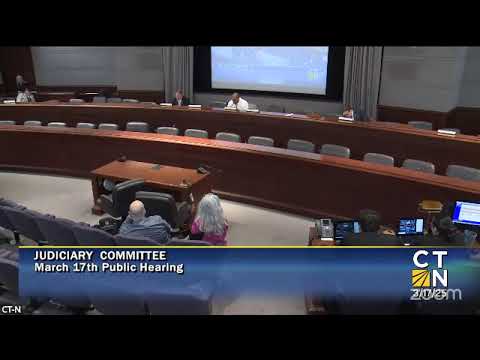
Hartford, Conn. — Advocates for survivors of gender‑based violence urged the Judiciary Committee on March 17 to pass Senate Bill 15‑02, a measure that would allow judges and the parole board to consider domestic violence, sexual assault, stalking or human trafficking as a contributing factor when reviewing or modifying criminal sentences.
Supporters — including the Connecticut Coalition Against Domestic Violence, She Leads Justice, Drop LWOP New England and the ACLU of Connecticut — told the committee the bill would give judges and other decision makers a formal way to weigh trauma and coercive control in cases where an individual’s offense was tied to their victimization.
“Survivors can sometimes receive severe sentences for actions directly tied to their victimization,” Megan Scanlon, CEO of the Connecticut Coalition Against Domestic Violence, told the committee. “SB 15‑02 increases judicial discretion by allowing judges to issue nuanced, trauma‑informed sentences while still retaining the power to deny relief if a survivor cannot prove that their victimization was a contributing factor.”
Proponents described many situations in which survivors are pushed into crime — from coerced participation to fighting back — and said current mandatory minimums can leave judges unable to factor that history fully into a sentence. Dr. Rishani Rees, a forensic psychologist and executive director of Drop LWOP New England, told the committee she has worked with incarcerated women who were victims of severe abuse before committing offenses and said the justice system needs a formal process to consider that context.
“SB 15‑02 has the power to create increased opportunities for victims and survivors in Connecticut to experience humanity and understanding from our justice system,” Tanisha Signore, policy director at She Leads Justice, said.
Committee members pressed witnesses on details: how claims of abuse would be proven, how the bill interacts with existing pre‑sentence reports and mandatory minimums, and whether the change would overwhelm the courts and victim‑notification systems. Witnesses said the bill is meant to create a predictable avenue — not an automatic release — and that courts already receive and consider many forms of evidence related to a defendant’s background, but that mandatory statutory floors can prevent judges from acting on that information.
Proponents pointed to other states that have passed similar laws, including New York and Oklahoma, and said implementation language can and should be tailored so decisions are evidence‑based and protect public safety while allowing courts to consider trauma when appropriate. Several witnesses emphasized the change would be used rarely and would require factual proof to the sentencing authority.
Supporters urged the committee to move the bill forward so judges, parole panels and commutation authorities can formally apply trauma‑informed analysis to cases where abuse meaningfully contributed to criminal behavior.
If the committee reports the bill, the next steps would be committee deliberation and potential floor consideration by the Connecticut General Assembly.
Sources: testimony from Megan Scanlon (Connecticut Coalition Against Domestic Violence), Tanisha Signore (She Leads Justice), Dr. Rishani Rees (Drop LWOP New England), and others at the March 17, 2025 Judiciary Committee public hearing.