Get Full Government Meeting Transcripts, Videos, & Alerts Forever!
Get email alerts on the Traffic Safety topic
No spam. Unsubscribe anytime.
DPS cites speed, impairment and seat-belt nonuse as main drivers of rising Minnesota road deaths
Summary
The Department of Public Safety told the Senate Transportation Committee that speed, impaired driving and lack of seat-belt use remain the top factors behind a recent rise in traffic fatalities and outlined programs — from data-driven enforcement pilots to community coalitions — intended to reduce deaths.
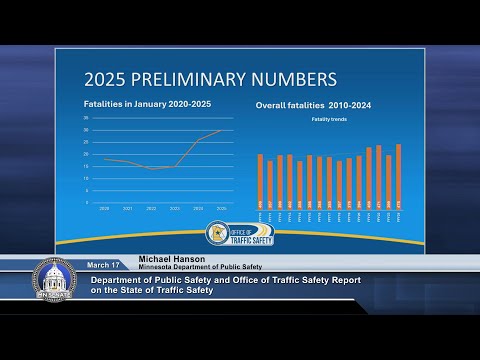
Mike Hanson, director of the Department of Public Safety’s Office of Traffic Safety, told the Minnesota Senate Transportation Committee on March 17 that speed remains the single biggest contributor to fatalities on state roads and that overall traffic deaths have trended upward since 2021.
Hanson said the department’s preliminary 2025 figures show an increase in January but cautioned those counts are provisional. "Speed continues to be our number 1 concern. Speed ... is the 1 thing that makes every other mistake or bad decision worse," Hanson told the committee.
The advisory council on traffic safety, which now houses the Toward 0 Deaths program, is coordinating engineering, education, enforcement and emergency-services strategies with MnDOT and the Department of Health, Hanson said. He described several ongoing efforts: a five-year Strategic Highway Safety Plan update with MnDOT; a subcommittee on traffic incident management; funding and support for roughly 20 locally led Safe Roads Coalitions (with about 30 additional unfunded coalitions active); and highway safety improvement projects targeted to crash history.
Hanson highlighted several initiatives enacted or funded by the 2023 Legislature: a statewide speed-reduction enforcement effort that involves nearly 300 law enforcement agencies; designation of "safe road zones" in 12 identified corridors combining infrastructure and behavioral strategies; and a pilot providing telehealth in ambulances in parts of the Arrowhead and southwest Minnesota funded with roughly $12–14 million in federal grants, which Hanson described as connecting trauma doctors to crews on scene.
On enforcement and public education, Hanson said the department funds more than 300 agencies for impaired-driving enforcement and runs paid and earned media waves timed to campaign windows such as distracted-driving awareness in April and Click It or Ticket in May. He described a first-of-its-kind Saint Cloud pilot that will combine historical crash data and near-real-time analytics to identify not only high-risk corridors but the days and times when those corridors are most dangerous; the pilot will run through the 100 deadliest days (Memorial Day–Labor Day) period.
Committee members asked for detail and context. Senator Howell asked which counties were included in the Saint Cloud pilot; Hanson said it covers Stearns, Sherburne and Benton counties and involves roughly 14–15 law enforcement agencies. Senator Dibble pressed for a breakdown of fatalities by roadway jurisdiction; Hanson said roughly 70% of Minnesota’s fatalities occur outside the seven-county Twin Cities metro and that about 60% of those rural fatalities occur on local (county, city or township) roads rather than on the state or U.S. trunk highway system.
Hanson and members also discussed the persistence of behaviors that emerged during the COVID period. Hanson said some bad driving habits formed during the pandemic have carried over: "We have a COVID hangover on our roads in the way that some continue to use them as a a private playground when in fact they're a public infrastructure." He cited staffing shortages in many law-enforcement agencies as a constraint on enforcement capacity.
On public education, Hanson outlined paid and earned media strategies and said the Office of Traffic Safety publishes an annual report to NHTSA documenting impressions and reach. He also described school- and peer-focused programs such as Project Teen Impact targeted to 10th graders. When asked whether education could be a sanction following traffic citations, Hanson said Minnesota currently lacks a standard post-ticket education sanction but that the idea could be explored.
Several members asked about weather impacts; Hanson said weather affects speeds and severity and that 2025 year-to-date fatality counts were lower than the same period in 2024 because winter weather in early 2025 slowed speeds and reduced severity. He noted 2024 ended with 478 traffic fatalities in Minnesota.
The committee heard that the Toward 0 Deaths framework seeks a holistic mix of engineering, education, enforcement and emergency services — and Hanson added a fifth element: "everyone," meaning community buy-in. The department presented its Road Safety Information Center, a public, mobile-friendly portal with crash statistics and local data, and asked committee members for feedback on the site.