Get Full Government Meeting Transcripts, Videos, & Alerts Forever!
Get email alerts on the Atv On Public Roads topic
No spam. Unsubscribe anytime.
Committee sends bill allowing limited ATV operations on public roads to next committee amid safety concerns
Summary
The House Transportation Finance and Policy Committee recommended House File 566 to pass and be referred to the Elections, Finance and Government Operations Committee after testimony from Greater Minnesota officials and safety concerns raised by MnDOT.
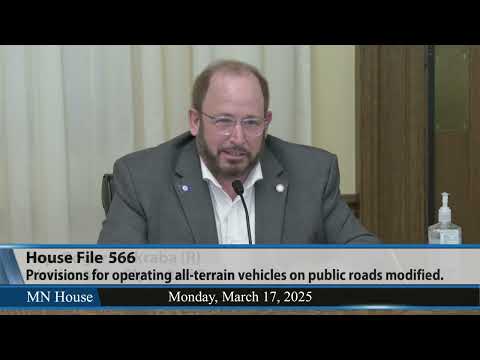
The House Transportation Finance and Policy Committee on March 17 recommended House File 566, a bill to modify state law to allow all-terrain vehicles (ATVs) to operate on designated public roads in some communities, and referred the measure to the Elections, Finance and Government Operations Committee.
Representative Scribe, the bill’s sponsor, told the committee the measure is aimed at Greater Minnesota towns where ATVs are commonly used as practical transportation. ‘‘This bill is critically important for Greater Minnesota cities and rural communities where ATVs are not just for recreation but also a practical mode of transportation,’’ Representative Scribe said.
Mayor Heidi Omerza of Ely testified in support, saying the bill would let her city link a new trailhead building directly to downtown and local businesses. ‘‘The ability to safely operate all terrain vehicles…is not just about recreation. It's about connectivity and accessibility,’’ Omerza said, adding that ATV tourism supports lodging, dining, fuel stations and equipment rentals in her region and generates ‘‘millions of dollars annually’’ for local economies.
Nick Wognum, secretary of the board for ATV Minnesota, described examples from small towns where state trunk highways serve as main streets and said residents have been ticketed for using ATVs to travel short local distances. ‘‘Small towns shouldn't have to penalize people who are just trying to get from one location to another,’’ Wognum said.
But Ken Johnson, assistant state traffic engineer at the Minnesota Department of Transportation (MnDOT), told the committee MnDOT and other safety partners have ‘‘serious concerns about safety’’ if the law is broadened. Johnson said ATVs ‘‘are not road worthy vehicles and don't meet Federal Motor Vehicle Safety Standards’’ and noted an increase in ATV‑involved fatal crashes, with 23 fatal crashes in 2024 compared with eight in 2023 and 14 in 2022. He said MnDOT staff ‘‘recommend that ATVs operate in the ditch or backslope whenever possible’’ and expressed concern that drivers might interpret a statutory change as allowing operation on any roadway with a certain speed limit.
Representative Scribe said he will meet with MnDOT to work on safety issues before the bill advances. The committee then voted to recommend the bill to pass and referred it to the Elections, Finance and Government Operations Committee.
The committee record shows supportive testimony from city and ATV‑industry witnesses and formal safety reservations from MnDOT and public safety partners; Representative Scribe signaled willingness to negotiate safety language before later consideration.