Get Full Government Meeting Transcripts, Videos, & Alerts Forever!
Get email alerts on the State Budget topic
No spam. Unsubscribe anytime.
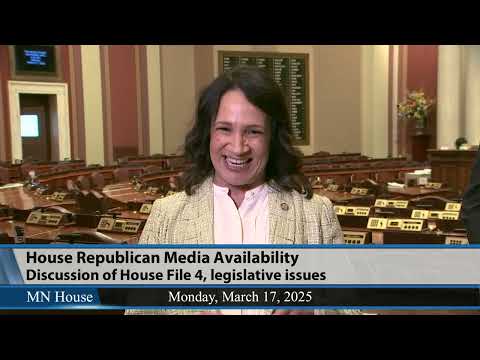
Minnesota House Republicans push constitutional amendment (House File 4) to return future surplus to taxpayers as tied chamber forces bipartisan votes
Summary
House Republicans introduced House File 4, a proposed constitutional amendment to require that any forecasted surplus greater than 5% of expenditures be set aside for future tax relief or savings; the measure was presented as the Minnesota House returns to an even partisan split, meaning bipartisan support will be required to advance legislation.
Speaker Damoth, the Minnesota House speaker, told reporters that House File 4 — a proposed constitutional amendment — is the "one big bill" on the floor and urged bipartisan support.
"We are hoping that our Democrat colleagues would join us in helping to return any potential future surplus back into the hands of the taxpayers of Minnesota. That's house file 4, and that would propose a constitutional amendment," the speaker said.
The proposal would create a mechanism to set aside any surplus that exceeds 5% above expenditures after the official forecast into an account for future tax relief or savings, the speaker said. The measure would first need to pass the Legislature and then be approved by voters to become part of the state constitution.
Representative Johnson, identified in the session as the chief author of House File 4, described the proposal as "an answer back to Minnesotans" who have said they want some money returned. "They would either go back at property taxes or income tax or some sort of tax relief, and that is basically us listening to the voters of Minnesota and taking action," Johnson said.
Republican leaders framed the amendment in the context of recent budget history. The speaker said that, over the past two years, there was an $18 billion surplus that "was completely spent," and that if a 5% surplus-return mechanism had existed then, "there would have been at least $5,000,000,000 if not more available to be returned to the taxpayers." The speaker also said the state now faces a roughly $6 billion deficit.
The speaker emphasized that the amendment would not provide immediate refunds. "It would put it on the ballot so that in the next election in '26, voters could determine whether or not this is the direction they would wanna go," the speaker said later in the session. A House staff member confirmed the bill, as discussed, would require both legislative passage and voter approval before funds could be redirected.
Lawmakers also discussed how the newly tied House — returned to a 68–68 split after a recent special election — will affect the bill's prospects. The speaker said co‑chairing arrangements will govern most committees (a Democrat and a Republican co-chair on many panels) and that committee work will need bipartisan cooperation. The session noted one exception: the fraud committee will remain chaired by Representative Kristen Robbins with a 5–3 Republican majority.
Several reporters asked whether Democrats had indicated willingness to break from party lines to support the amendment. Representative Johnson said he had not identified any Democrats willing to break with their leadership yet but expressed hope that members would change their positions as they learned more about the proposal.
On budget context, the speaker and others discussed broader fiscal priorities and constraints. They cited recent increases in state spending, said roughly 6,000 full-time equivalent positions were added to state government in the prior budget cycle, and named health and human services and education as the state's largest spending categories. The speaker also cited a $730,000,000 office expansion near the Capitol as an example of prior spending decisions under scrutiny.
The speaker said the House leadership is seeking to complete a balanced budget by the chamber's internal target of May 19 and that leaders will meet with the governor and other legislative leaders to discuss targets and the adjusted budget. The session included requests to state agencies for information on office usage and staffing (including positions with diversity, equity or inclusion in their titles); according to the speaker, the House received only partial information so far.
No formal vote on House File 4 was recorded during the floor remarks summarized in this transcript. Lawmakers described the measure as calendared for floor consideration and said, if advanced by the Legislature, it would be placed on the November 2026 ballot for voter approval.
Looking forward, the speaker characterized the tied House as likely to require more committee collaboration and warned that passing measures will be "bumpy" without cross‑aisle support. The speaker and Representative Johnson both said they hope to persuade colleagues to support the amendment but acknowledged the multi-step process and the need for bipartisan majorities to move legislation forward in a tied chamber.
Ending: House File 4 remains under consideration; sponsors say the proposal would not take effect without subsequent voter approval and will require bipartisan support to advance in the evenly split House.