Get Full Government Meeting Transcripts, Videos, & Alerts Forever!
Get email alerts on the Education Grading topic
No spam. Unsubscribe anytime.
Manhattan CB2 members press DOE for citywide grading policy during remote learning
Summary
Community Board 2 Schools & Education Committee members, parents and CEC representatives urged the Department of Education to issue citywide guidance on grading during remote learning, with many expressing support for a pass/fail (binary) model for the year accompanied by teacher narrative comments to address equity and admissions concerns.
Members of the Manhattan Community Board 2 Schools & Education Committee met by video conference to press the New York City Department of Education for a single, citywide grading policy during the district’s period of remote instruction.
Committee members, school parents and representatives of the District 2 Citywide Education Council said inconsistent local grading decisions risked amplifying existing inequities and creating confusion for families applying to middle and high schools. The committee agreed to draft a resolution urging DOE guidance; members indicated a majority preference for a binary/pass‑fail model for the year, paired with teacher narrative comments.
The issue framed the meeting: Janine (committee organizer) opened the call saying the main agenda item was “grading during remote learning.” Mar Fitzgerald, a public member of the committee, summarized the stakes: “Who cares about grading? I think the quick answer is everyone.”
Speakers described how remote instruction has affected different students. The committee’s presentation included districtwide figures cited during the call: 73 percent of New York City students live in poverty (about 819,000 students), roughly 300,000 students (about 27 percent) lacked access to Wi‑Fi or a reliable device when remote learning began, 20 percent are students with diagnosed disabilities (IEPs), 13 percent are English language learners and 12 percent live in temporary housing. Committee members said those disparities shape how grading choices will help or harm students.
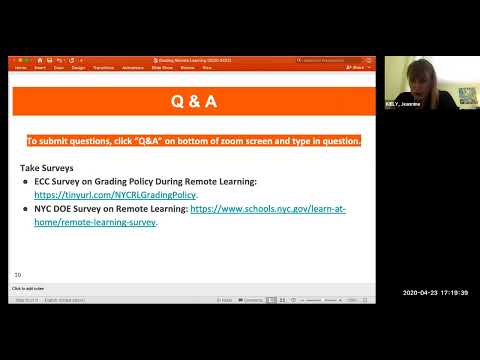
Parents and CEC members told the committee they want systemwide clarity. Tricia Joyce, chair of the Schools and Education Committee for Community Board 1, and Emily Hillstrom, a CEC District 2 member, said families and parent leaders reported steep drops in performance for students with learning disabilities and stressed the need for consistency across schools. Robin Broshy, representing the ECC survey effort, said nearly 12,000 responses had been collected citywide and that “a large majority want a citywide direction.”
Several grading approaches drew discussion: keep grades unchanged (average for the year), drop the lowest grade or allow grades only to rise, apply pass/fail for the remote period only, or adopt pass/fail for the full year. Committee members repeatedly raised the particular impact on students in admissions years (fourth, seventh and eleventh grades) and asked how any change would affect middle‑ and high‑school admissions calculations.
Supporters of a citywide binary approach argued it would protect vulnerable students from being penalized by circumstances beyond their control and would reduce pressure on attendance and participation. Opponents and some teachers’ representatives warned about unintended consequences: a blanket policy could reduce student engagement (school officials cited San Francisco’s experience with a universal A grade leading to lower attendance) or complicate technical reporting and admissions algorithms unless the DOE sets clear standards.
The committee discussed several clarifying additions to any policy: require teacher narrative comments or diagnostic assessments so hiring schools and families can understand each student’s performance; issue uniform DOE guidance rather than leave decisions to individual schools; and use diagnostics over the summer and early fall to measure learning loss and target remediation.
After extended discussion, the committee’s chair said she would revise a draft resolution and circulate it for committee approval. Janine said the draft will call for citywide DOE guidance and incorporate the committee’s preference that any citywide model include narrative commentary from teachers and a commitment to diagnostics and planning over the summer.
The committee did not adopt a formal binding vote during the meeting; members agreed to circulation and further action. The committee also asked that the DOE and CEC continue collecting parent input and that diagnostic assessments be prioritized so schools can target supports if remote learning continues.
The committee identified next steps: circulate the draft resolution for approval, forward feedback from parents and the ECC/CEC surveys to the DOE, and schedule follow‑up conversations focused on learning diagnostics and planning for the fall.
Ending
Committee members and parent representatives emphasized two recurring priorities: equity for students with limited devices, English‑language learners and students with disabilities; and clarity on how grading changes would affect admissions. The committee will circulate a draft resolution reflecting those concerns and the majority preference expressed during the meeting; it asked the DOE to provide citywide guidance before schools finalize local grading policies.