Get Full Government Meeting Transcripts, Videos, & Alerts Forever!
Get email alerts on the Public Safety Fire topic
No spam. Unsubscribe anytime.
Leland staff propose fire code clarifications; council discusses open-burning limits and costs
Summary
Building and fire officials proposed clarifying amendments to the town's fire-prevention provisions, including changing fire-lane markings from yellow to red and making emergency radio coverage requirements explicit. Council also discussed broader open-burning bans and the cost of townwide vegetative pickup as an alternative.
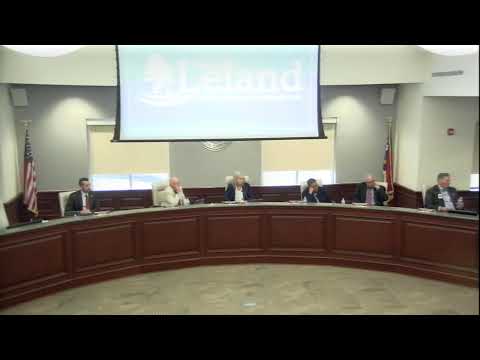
Town of Leland staff on Tuesday presented proposed amendments to the town's fire prevention rules and answered council questions about open burning and enforcement.
Daniel Knox, the town's chief building official, described targeted changes to the town's Fire Prevention Ordinance intended to align local language with the updated state and model fire code. The draft amendments would revise wording in several sections, clarify what constitutes a hazardous condition, make the town's existing policy explicit that buildings failing emergency responder radio coverage tests must install a system before any certificate of occupancy is issued, and change the marking color for required fire lanes from yellow to red to improve visibility.
Knox said the radio-coverage language is meant to avoid requests for temporary occupancy when life-safety systems have not been validated. "This clarification is really... we've had some instances where there have been requests to get a temporary certificate of occupancy on a building without one, and so we want to make it clear, this is a life safety fire protection system," Knox said.
Council members asked about the choice of red for fire-lane markings. One councilmember summarized the reasoning during the discussion: "The yellow kind of says, no, you can park here but be careful. The red says, don't park here." Staff said the change is intended to reduce confusion with other yellow traffic markings such as loading zones.
The presentation sparked a separate discussion about on-street parking opposite fire lanes near the Harris Teeter shopping area and the town's ability to address private property and access issues. Staff said they and the fire department will inspect and evaluate fire lanes in complex developments and, where necessary, engage property owners and the fire chief to resolve access problems.
Council also returned to a long-running conversation about open burning. A councilmember urged staff to explore whether the town could ban open burning inside municipal limits and asked staff to investigate the practical costs of providing vegetative debris pickup as an alternative. Staff said municipalities take different approaches: Wilmington runs its own program and can ban open burning within city limits; some smaller towns contract a third party and charge roughly $15 per household per month (about $180 per year) to cover vegetative pickup. Staff warned that even a municipal burn ban would not eliminate smoke originating outside town boundaries and that some state authority (Division of Forestry or state rules) still governs large-scale burn restrictions. The meeting also highlighted that state law limits local burn bans to within a specified distance from structures (commonly 100 feet), which constrains local reach.
Town staff and council members noted additional trade-offs: if developers cannot burn cleared vegetation on site, the material must be hauled away by truck, increasing heavy-vehicle traffic and wear on town streets. Staff also noted that the Division of Air Quality will only act if emissions cross enforceable state thresholds.
No formal ordinance change was adopted at the meeting. Staff said they will consult with the fire chief on specific fire-lane issues, continue drafting proposed code clarifications for the fire-prevention ordinance, and research options and costs for the vegetative pickup model council asked staff to explore.
Ending: Staff will return with more detailed draft language for the fire-prevention ordinance and with cost estimates and implementation options for an open-burning alternative; any change would return to planning and council for public hearings and formal votes.