
Flagstaff candidates outline housing, climate and budget priorities at city manager forum
Get AI-powered insights, summaries, and transcripts
Subscribe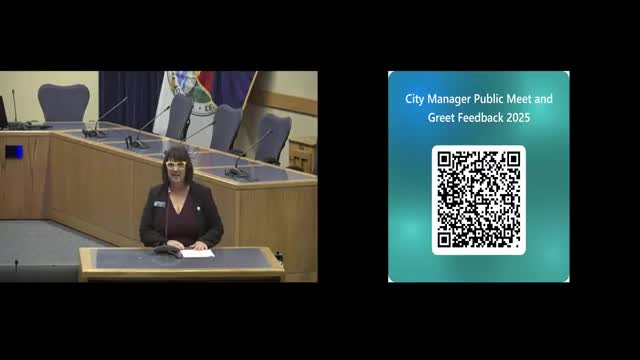
Summary
Two finalists for City of Flagstaff city manager — Doug Schultz and Joanne Keane — presented their plans for balancing sustainability, social equity and economic development at a public forum and answered audience questions on housing, economic diversification, budget transparency and accessibility.
At a public forum in Flagstaff, the two finalists for city manager — Doug Schultz and Joanne Keane — laid out their backgrounds and priorities and answered audience questions about housing, economic diversification, climate action, budget transparency and disability access.
The forum gave both finalists time to introduce themselves and to respond to three prepared questions about engaging community partners, addressing the housing shortage and implementing the city’s climate goals. Doug Schultz described a long career in local government, saying he has served as a city manager for more than three decades and stressed accessibility and stakeholder outreach. Joanne Keane, the city’s deputy city manager and a 20-year Flagstaff resident, emphasized balancing competing goals and implementing the council-declared housing and climate emergencies while continuing capital projects and services.
Why it matters: the city manager oversees daily operations and implements council policy; the next hire will have primary responsibility for advancing the council’s housing and carbon-neutrality goals and for day-to-day management of the city budget and staff.
Background and priorities Doug Schultz, introduced as a finalist, described decades of municipal experience in Minnesota, Washington and California and urged active community engagement, saying the structure of a city manager and deputies should allow time for outreach. Schultz pointed to past work where public–private partnerships and land trusts produced permanently affordable units and cited examples of attracting private development, municipal utility renewable-energy purchases and programs to streamline developer approvals.
Joanne Keane, identified in the forum as deputy city manager for the City of Flagstaff and one of the finalists, described her 25 years in public service across local, state and higher-education roles and said she has overseen planning, capital projects, sustainability and financial services for Flagstaff. Keane stressed that sustainability, social equity and economic development sometimes compete and said the city must use adopted plans — including the council-declared climate and housing emergencies, the 10-year housing plan and a regional plan that will be on the ballot in May — to guide decisions.
Housing and short-term rentals Both candidates said housing is the city’s most urgent local challenge and described multiple approaches rather than a single fix. Schultz gave examples from his prior work where cities used housing authorities, land trusts and targeted partnerships to create permanently affordable units. Keane pointed to Flagstaff’s existing tools — a council-declared housing emergency, a 10-year housing plan and a voter-approved bond — and described ongoing projects with the Flagstaff Unified School District, Mountain Line and Flagstaff Housing Authority as examples of efforts already under way.
Audience members pressed candidates for concrete steps. Rick Lopez, a longtime Flagstaff resident and former city council member, said second-home purchases and short-term rentals have pushed local housing prices and asked what the candidates would do “with some degree of urgency” after five years of a declared housing emergency. Keane noted state limits on short-term rental regulation but said she expects momentum at the state level to restore more local authority. She also described local measures the city is exploring, such as timing windows that might give local buyers a chance to purchase homes before they are sold out of the area. Schultz emphasized streamlining approvals and targeted recruitment of developers that will build the housing the community needs, while preserving environmental protections.
Economic diversification and tourism dependence Both finalists said Flagstaff’s tourism dependence poses risks. Keane described plans to diversify revenue and jobs, including a potential research park on 32 acres at Flagstaff’s airport property. Schultz suggested targeting industries that fit Flagstaff’s values (for example, health care, micro-industrial services, or green-technology jobs) and pointed to successes elsewhere where a community recruited film studios or supported clustering of business services to expand local employment.
Climate action and sustainability Both candidates said they support the council’s climate emergency declaration and described steps the city could take. Keane highlighted internal city actions — fleet electrification, building retrofits, virtual power purchase agreements and renewable-energy projects — and said the city should “walk the walk.” Schultz cited experience purchasing renewable power through a municipal utility in a prior city and urged collaboration with regional electric providers, expanded rooftop solar and more charging stations to support electric vehicles.
Budget transparency Michelle James, executive director of Friends of Flagstaff Future, asked how candidates would make the city budget easier for residents to understand. Keane and Schultz both recommended clearer public summaries, more regular high-level revenue updates and use of online transparency tools. Schultz specifically cited platforms such as OpenGov and the fiscal-health modules of priority-based budgeting to model long-term impacts of council decisions. Keane said Flagstaff currently uses priority-based budgeting and said she would promote clearer midprocess summaries of the city manager’s proposed budget.
Accessibility and ADA compliance A question from Bridal Fyle of Barrier Free Flagstaff asked about municipal work on Americans with Disabilities Act compliance. Keane described prior responsibility for equity and access work while at Northern Arizona University and said she would continue capital improvements, retrofits and engagement with the local advocacy group. Schultz said he would incorporate accessibility upgrades into capital planning.
Public feedback and next steps The forum host asked attendees to submit feedback using a displayed QR code; candidates will be considered along with comments sent to council. No final appointment was made at the event.
Speakers quoted in this article appear as they were identified at the forum.