Get Full Government Meeting Transcripts, Videos, & Alerts Forever!
Get email alerts on the Zoning Land Use topic
No spam. Unsubscribe anytime.
Planning board approves rooftop cover expansion at Kosher House with added noise monitoring
Summary
The Hollywood Planning and Development Board unanimously approved a variance allowing Kosher House to expand a roof-covered amenity area above an existing restaurant, subject to staff conditions and an additional decibel monitor after neighbors raised noise concerns.
The Hollywood Planning and Development Board on Tuesday approved a variance allowing Kosher House LLP to expand a roof-covered amenity area above the restaurant at 5510–5530 S. State Road 7, with conditions that include an additional noise-monitoring device and potential enforcement actions if limits are exceeded.
The request sought to increase the roof-covered seating area from the previously approved 2019 coverage (about 28–30% of the roof) to a combined proposed cover of approximately 2,663 square feet (about 52% of the roof). City staff told the board the proposal is “inconclusive with the zoning and land development regulations” but consistent with the comprehensive and citywide master plans; staff recommended the board determine whether to approve the variance and offered conditions including interior noise monitoring and penalties for noncompliance.
Neighbors and the applicant told the board they had both made changes since a prior December 2024 hearing. Applicant counsel Rod Feiner and project representatives said live music was limited to special events, recorded music remained, and one rooftop speaker had been removed since the prior hearing. Feiner said the expanded permanent roof would allow ceiling fans and shield lighting, and that the use is permitted in the Transit Oriented Corridor zoning created for the 441 corridor.
Some neighbors said noise had improved but that bass and amplified sound had previously been severe. Beverly Robinson, who lives near the property, told the board, “It’s almost unlivable. It’s like they’re trying to run us out of our neighborhoods because people are moving because of this. They’re actually selling their homes so they can sleep.” Other commenters, including frequent patrons, said the expansion would help customers during rain and was consistent with the corridor’s entertainment-oriented zoning.
After discussion the board approved the variance with staff’s recommended conditions and an explicit clarification that the applicant must install an additional noise-monitoring device (not replace existing monitors). The board’s roll-call vote was unanimous.
The board record notes prior code-enforcement contacts and a building permit tied to one outstanding violation; staff said a certificate of use permits a bar/restaurant and that the liquor-license hours limit alcohol sales to 2 a.m. (sales prohibited between 2 a.m. and 7 a.m.), while the business’s posted hours on its website were roughly 7 a.m. to 1 a.m. The staff recommendation warns that failure to comply with monitoring or noise limits could lead to citations, reduced operating hours or revocation of rooftop privileges.
Board members and staff repeatedly emphasized that enforcement of noise and operating-hour limits will fall to code enforcement and that monitoring devices should be positioned in locations selected by the director of code compliance so readings can be verified. The applicant agreed to the additional device condition and to work with code enforcement on placement.
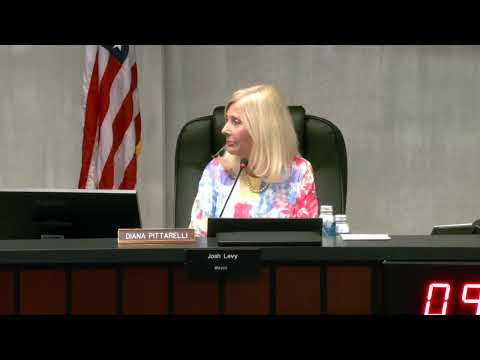
The motion passed on a unanimous roll-call vote recorded as: Kenneth Crawford — yes; Joseph Stadlin — yes; Steven Morales — yes; Mena Morgan — yes; Bob Glickman — yes; Diana Pitarelli — yes; Richard Blattner — yes.
The board closed the item after the vote; the applicant may proceed with permits and the additional monitoring device installation per the conditions adopted by the board.